
Utilizando modelos semiempíricos de los espectros de fotoabsorción de varios fullerenos individuales (C_80, C_240, C_320 y C_540) predecimos transiciones en la región de la banda difusa más intensa del medio interestelar a 4430 A que podrían explicar su origen, hasta ahora desconocido. Estos modelos también presentan una alta densidad de transiciones en el ultravioleta que reproducen el denominado "bump" a 2175 A en la curva de extinción del medio interestelar (Iglesias-Groth 2004). Parece que los fullerenos podrían ser responsables de dos de los mayores rasgos de la absorción interestelar. Haciendo uso de las secciones eficaces teóricas y de los datos empíricos estimamos que la abundancia de fullerenos es de 0.05 moléculas por millón de átomos de hidrógeno en regiones del medio interestelar con índice de exceso de color E(B-V)~ 1.0.
Advertised on
It may interest you
-
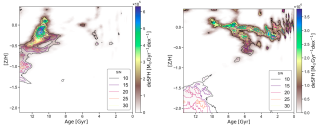 Research on the formation, origin, and evolution of the dichotomy between the thin and thick disk components of the Milky Way has been a major topic of study, as it is key to understanding how our Galaxy formed. However, this is not an easy task, since populations defined by their morphology or kinematics show a mixture of chemically distinct stellar populations. Age therefore becomes a fundamental parameter for understanding the evolution of the Galactic disk. Our goal is to derive the age and metallicity distributions of the thin and thick disks defined kinematically, in order to revealAdvertised on
 -
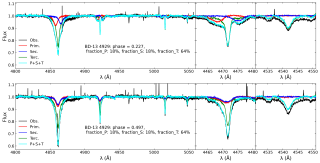 The most massive stars in the universe are often born and evolve in binary and multiple systems — that is, in pairs or groups bound by their mutual gravity. Understanding how they interact with each other is key to explaining everything from their formation to the impact they have on the galaxies they inhabit. The MONOS project (Multiplicity Of Northern O-type Spectroscopic systems) aims to study these systems in the northern sky, combining spectroscopic observations (which analyze light split into its component colors to measure stellar velocities and physical properties) with photometryAdvertised on
 -
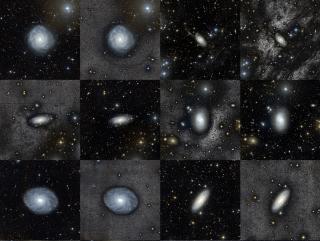 In the standard Lambda cold dark matter (Lambda-CDM) cosmology, galaxies grow by gradually accreting material and through mergers with other galaxies. This scenario successfully explains many large-scale cosmic structures, yet it struggles to account for the existence of numerous massive spiral galaxies in the local Universe that lack a prominent central bulge, pure disc systems, in the local Universe. Understanding how these galaxies form and survive is also essential for placing our own Galaxy, the Milky Way, into context, as it also hosts a low-mass bulge. In this study, we analyse 22Advertised on