A team from the Instituto de Astrofísica de Canarias (IAC) has tested a new technique capable of rapidly identifying the distortions that light undergoes as it passes through Earth’s atmosphere. The development, carried out by the Laboratorio para la Innovación en Optomecánica (LIOM) within the framework of the CELESTE project, could in the future contribute to the creation of more compact and simpler adaptive optics systems to improve the quality of astronomical observations. The technology combines an optical fibre approximately one centimetre long with artificial intelligence techniques
The Instituto de Astrofísica de Canarias (IAC) has successfully completed a technological milestone of great significance: the “Redundancy of the RedIRIS Tenerife–La Palma Maritime and Terrestrial Optical Network” project. This new and robust optical communications network guarantees the continuity of the data highways for the Canary Islands’ observatories — the Teide Observatory (OT) in Tenerife and the Roque de los Muchachos Observatory (ORM) in La Palma — ensuring their connectivity in the event of any technical or environmental contingency. This achievement is the result of a joint
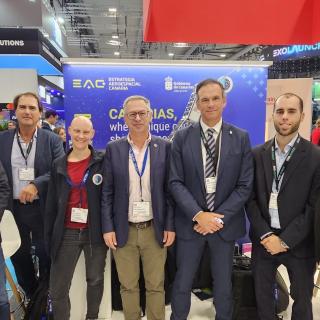
The Instituto de Astrofísica de Canarias (IAC), through IACTEC-Space, is participating this week in Space Tech Expo Europe, the largest space industry trade fair on the continent, held in Bremen from November 18 to 20. The team is located in the Spain Space pavilion, alongside the Canary Islands Aerospace Strategy (EAC), to showcase the technological developments of the CELESTE laboratories and strengthen international collaborations in the space sector. The I nstituto de Astrofísica de Canarias (IAC) is participating once again in Space Tech Expo Europe, the leading event for the space