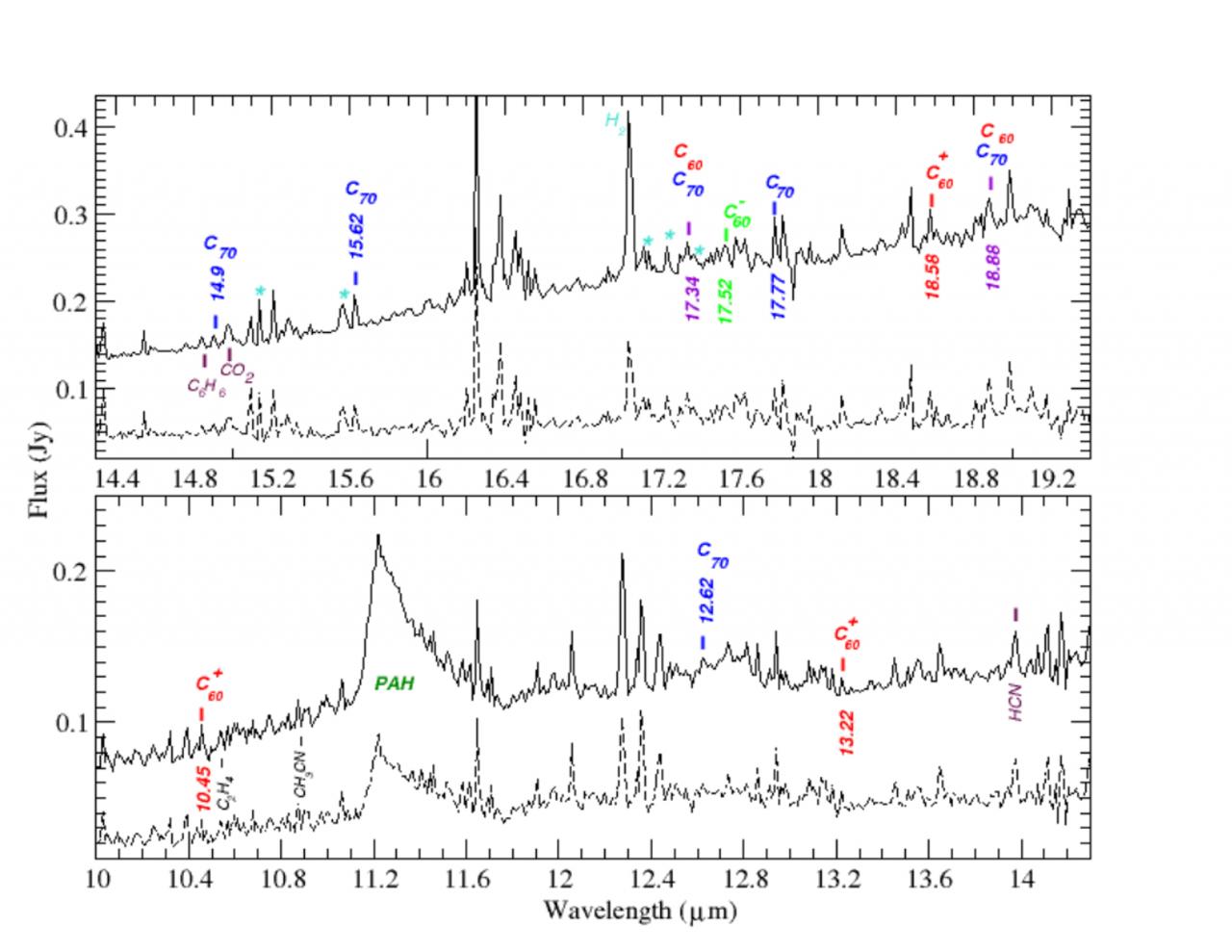
We present the detection of fullerenes C60 and C70 in the star-forming region IC 348 of the Perseus molecular cloud. Mid-IR vibrational transitions of C60 and C70 in emission are found in Spitzer IRS spectra of individual stars (LRLL 1, 2, 58), in the averaged spectrum of three other cluster stars (LRLL 21, 31, and 67) and in spectra obtained at four interstellar locations distributed across the IC 348 region. Fullerene bands appear widely distributed in this region with higher strength in the lines of sight of stars at the core of the cluster. Emission features consistent with the three most intense bands of the C60+ and with one of C60- are also found in several spectra, and if ascribed to these ionized species it would imply ionization fractions at 20 and 10 per cent, respectively. The stars under consideration host protoplanetary discs, however the spatial resolution of the spectra is not sufficient to disentangle the presence of fullerenes in them. If fullerene abundances in the cloud were representative of IC 348 protoplanetary discs, C60, the more abundant of the two species, could host 0.1 per cent of the total available carbon in the discs. This should encourage dedicated searches in young discs with upcoming facilities such as the JWST. Fullerenes provide a reservoir of pentagonal and hexagonal carbon rings which could be important as building blocks of prebiotic molecules. Accretion of these robust molecules in early phases of planet formation may contribute to the formation of complex organic molecules in young planets.
Averaged Spitzer spectra in the MIR of LRLL 21, 31 and 67, solid line and 4 interstellar locations (broken line) in IC348. The location of Fullerenes, organic molecules and water are indicated.
It may interest you
-
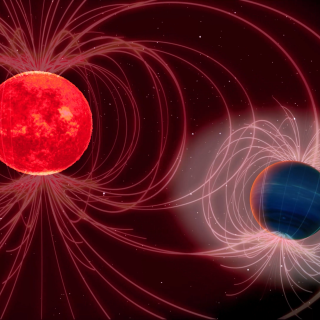
The Instituto de Astrofísica de Canarias (IAC) is taking part in an international study, published in the journal "Science", which provides the first conclusive evidence of a planet’s influence on the behaviour of its star. The results have made it possible to detect and estimate the strength of the magnetic field of the exoplanet GJ 436 b, opening up a new avenue for studying the habitability of planets outside the Solar System. Magnetic fields play a fundamental role in the habitability of planets. On Earth, the magnetic field acts as a shield against the solar wind and contributes to theAdvertised on -
The most massive stars in the universe are often born and evolve in binary and multiple systems — that is, in pairs or groups bound by their mutual gravity. Understanding how they interact with each other is key to explaining everything from their formation to the impact they have on the galaxies they inhabit. The MONOS project (Multiplicity Of Northern O-type Spectroscopic systems) aims to study these systems in the northern sky, combining spectroscopic observations (which analyze light split into its component colors to measure stellar velocities and physical properties) with photometryAdvertised on -
Researchers from the Instituto de Astrofísica de Canarias (IAC), in collaboration with the Instituto de Ciencias del Cosmos de la Universidad de Barcelona (ICCUB) and the Instituto de Estudios Espaciales de Cataluña (IEEC), have carried out the largest observational study to date on massive runaway stars including rotation and binarity in the Milky Way. This work, recently published in Astronomy & Astrophysics , sheds light on how these stellar “fugitives” are launched into space and what their properties reveal about their intriguing origins. Runaway stars are stars that travel throughAdvertised on