
Recent observations of the rotation curve of M31 show a rise of the outer part that cannot be understood in terms of standard dark matter models or perturbations of the galactic disk by M31?s satellites. Here, we propose an explanation of this dynamical feature based on the in?uence of the magnetic ?eld within the thin disk. We have considered standard mass models for the luminous mass distribution, a Navarro?Frenk?White model to describe the dark halo, and we have added up the contribution to the rotation curve of a magnetic ?eld in the disk, which is described by an axisymmetric pattern. Our conclusion is that a signi?cant improvement of the ?t in the outer part is obtained when magnetic effects are considered. The best-?t solution requires an amplitude of ?4 ?G with a weak radial dependence between 10 and 38 kpc.
Advertised on
References
(2010) The Astrophysical Journal Letters, Volume 723, Issue 1, pp. L44-L48
It may interest you
-
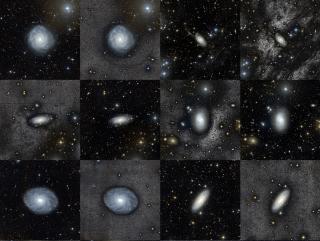 In the standard Lambda cold dark matter (Lambda-CDM) cosmology, galaxies grow by gradually accreting material and through mergers with other galaxies. This scenario successfully explains many large-scale cosmic structures, yet it struggles to account for the existence of numerous massive spiral galaxies in the local Universe that lack a prominent central bulge, pure disc systems, in the local Universe. Understanding how these galaxies form and survive is also essential for placing our own Galaxy, the Milky Way, into context, as it also hosts a low-mass bulge. In this study, we analyse 22Advertised on
-
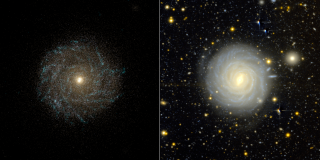 In the standard cosmological model (𝜦CDM), galaxies are merely the visible "tips of the icebergs," residing within massive, invisible cocoons of dark matter known as haloes. While these haloes dictate the evolution and motion of galaxies, measuring their true size and mass has long been one of the most challenging tasks in astrophysics. A new study published in Astronomy & Astrophysics by Claudio Dalla Vecchia and Ignacio Trujillo from the Instituto de Astrofísica de Canarias (IAC) proposes a breakthrough: a physically motivated definition of a galaxy’s edge that acts as a precision "ruler"Advertised on
-
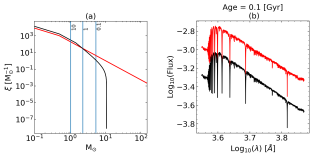 We present, for the first time, model spectra of single-age, single-metallicity stellar populations computed with the E-MILES evolutionary synthesis code incorporating an environment-dependent, variable galaxy-wide initial mass function (gwIMF). This gwIMF, calculated using the GalIMF code, is rooted in the integrated galactic initial mass function (IGIMF) theory, which predicts IMF variations as a function of the star formation rate and the metallicity. By coupling these two codes, we generated a comprehensive library of single-burst stellar population spectra uniquely sensitive to gwIMFAdvertised on