
Recent observations of the rotation curve of M31 show a rise of the outer part that cannot be understood in terms of standard dark matter models or perturbations of the galactic disk by M31?s satellites. Here, we propose an explanation of this dynamical feature based on the in?uence of the magnetic ?eld within the thin disk. We have considered standard mass models for the luminous mass distribution, a Navarro?Frenk?White model to describe the dark halo, and we have added up the contribution to the rotation curve of a magnetic ?eld in the disk, which is described by an axisymmetric pattern. Our conclusion is that a signi?cant improvement of the ?t in the outer part is obtained when magnetic effects are considered. The best-?t solution requires an amplitude of ?4 ?G with a weak radial dependence between 10 and 38 kpc.
Advertised on
References
(2010) The Astrophysical Journal Letters, Volume 723, Issue 1, pp. L44-L48
It may interest you
-
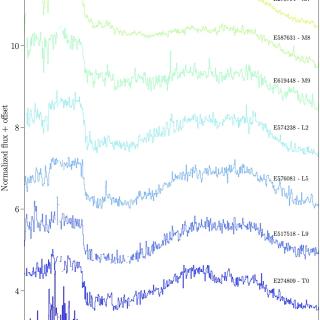 The Near-Infrared Spectrometer and Photometer (NISP) on board the Euclid space mission has obtained near-infrared (NIR) spectra of millions of objects, including hundreds of ultracool dwarfs (UCDs). Euclid observations retrieve images and slitless spectra simultaneously. This observing mode marks a new era in the discovery of new objects, such as L- and T-type dwarfs, which can be found from direct identification through the H2O and CH4 absorption bands. NISP spectral resolution (R ∼ 450) is enough to classify the objects by the spectral type using known standard templates. Q1 provided moreAdvertised on
-
 Research on the formation, origin, and evolution of the dichotomy between the thin and thick disk components of the Milky Way has been a major topic of study, as it is key to understanding how our Galaxy formed. However, this is not an easy task, since populations defined by their morphology or kinematics show a mixture of chemically distinct stellar populations. Age therefore becomes a fundamental parameter for understanding the evolution of the Galactic disk. Our goal is to derive the age and metallicity distributions of the thin and thick disks defined kinematically, in order to revealAdvertised on
-
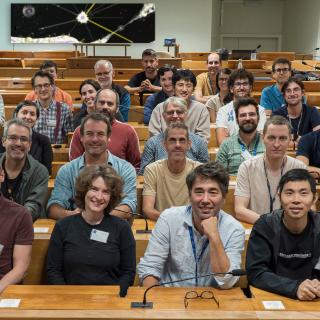 The Instituto de Astrofísica de Canarias (IAC), through the European UNDARK project and together with CERN, has brought together international experts in cosmology, astrophysics and theoretical physics to analyse some of the discrepancies that are challenging our current understanding of the Universe. The aim is to determine whether they arise from effects in the observations that are not yet fully understood, or whether they conceal unknown physical phenomena still waiting to be discovered. We know more about the Universe than at any other time in history, and we can measure some of itsAdvertised on