OTELO
Overview
OTELO (OSIRIS Tunable Emission Line Object survey) is a deep emission-line survey which takes advantage of Tunable Filter (TF) facility of the intrument OSIRIS on GTC, an unique facility in 8-10m class telescopes. The TFs had been configured to cover a selected atmospheric window (around 8950-9300 Å) relatively free of sky emission lines [1]. The survey produces 3D data cubes (proyected position + wavelength) from which a pseudo spectra can be extracted. The pseudo spectra is obtained from, typically, 36 TF images (filter width of 12 Å) at wavelengths covering a spectral range of 230 Å with a spectral of R ∼ 700.
Thanks to the use of ancillary data to estimate the redshift of the source, it is possible to identify the observed emission lines, (including the deblending of Hα from the [NII]λ658.3,654.8 nm lines at redshift z ∼ 0.4), allowing to determine the nature and physical properties of the different sources.
The survey studies a defined volume of the Universe with a 5σ depth of 1x10-18 erg.cm-2.s-1, which makes OTELO one of the deepest emission-line survey to date.
The figure shows some examples of OTELO emission line pseudo-spectra at the region around [O III]λ495.9 + 500.7 nm @ z ∼ 0.8; the Hα λ656.3 nm and [NII]λ658.3,654.8 nm lines @ z ∼ 0.4; or an object with an isolated emission line (to be analyzed).
| Property | Value |
|---|---|
| Centre coordinates (J2000.0) |
α: 14h17m33s,
δ: +52ª 28' 22"
|
| Spatial coverage | 56 arcmin2 |
| FWHM | 12 A |
| Sampling interval |
6 Å
(Hα + NII deblending)
|
| Wavelength accusracy | 1 Å |
|
Limiting magnitude
3 σ, 50% completeness
|
26.53 AB |
| Minimun EW | 5 Å |
| Photometric acurracy S/N > 2 | +/-0.05 mag |
| Redshift accuracy | ~5% up to z=1.4 |
| Ancillary data | Deep X-Ray to FIR (500 microm) |
| Source counting | |
| Total sources extracted | 11.237 |
| Bona fide emitters | 1.030 |
| Candidate emitters | 2.253 |
| Bona fide absorberes | 147 |

Figure: Examples of OTELO pseudo-spectra: Top-right: Region around [O III]λ495.9 + 500.7 nm @ z ∼ 0.8; Bottom-left: Region around the Hαλ656.3 nm and the [NII]λ658.3,654.8 nm lines @ z ∼ 0.4; Bottom-right: Isolated emission line (to be analyzed)
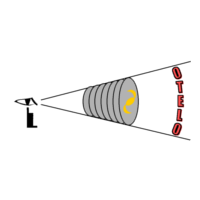
top-left: squematic view of TF technique; figure adapted from Jones, Shopbell & Bland-Hawthorn (2002) MNRAS 329, 759
Keywords: GTC - OSIRIS - Tunable Filters - Emission Line objects
[1] Sky lines at the ORM, where GTC is sited, and wavelength covered by OTELO survey.

Figure adapted from http://www.ing.iac.es/astronomy/observing/conditions/