Helio and Astero-Seismology and Exoplanets Search

    General
    Description

    The principal objectives of this project are: 1) to study the structure and dynamics of the solar interior, 2) to extend this study to other stars, 3) to search for extrasolar planets using photometric methods (primarily by transits of their host stars) and their characterization (using radial velocity information) and 4) the study of the planetary atmospheres.

    To reach our first objective, we use Global Helioseismology (analysis of the solar oscillation eigenmodes) and Local Helioseismology (that uses travel waves). Solar seismology allows to accurately infer information about the internal structure and dynamics of the Sun,. This project covers the various necessary aspects to attain the aforementioned objectives: instrumental, observational, reduction, analysis and interpretation of data and, finally, theoretical developments of inversion techniques and development of structure and evolution models.

    On the other hand, the Astroseismology aims to obtain a similar knowledge of other stars. Thanks to the huge number of stars observed by CoRoT, Kepler and TESS space missions it is possible to extract seismic global parameters of hundreds of stars; both solar type and red giants. Furthermore, the recent deployment and beginning of observations with the high precision spectrographs of the SONG (Stellar Observations Network Group) ground-based telescopes will substantially improve the characterization of the eigenmodes spectrum in bright stars.

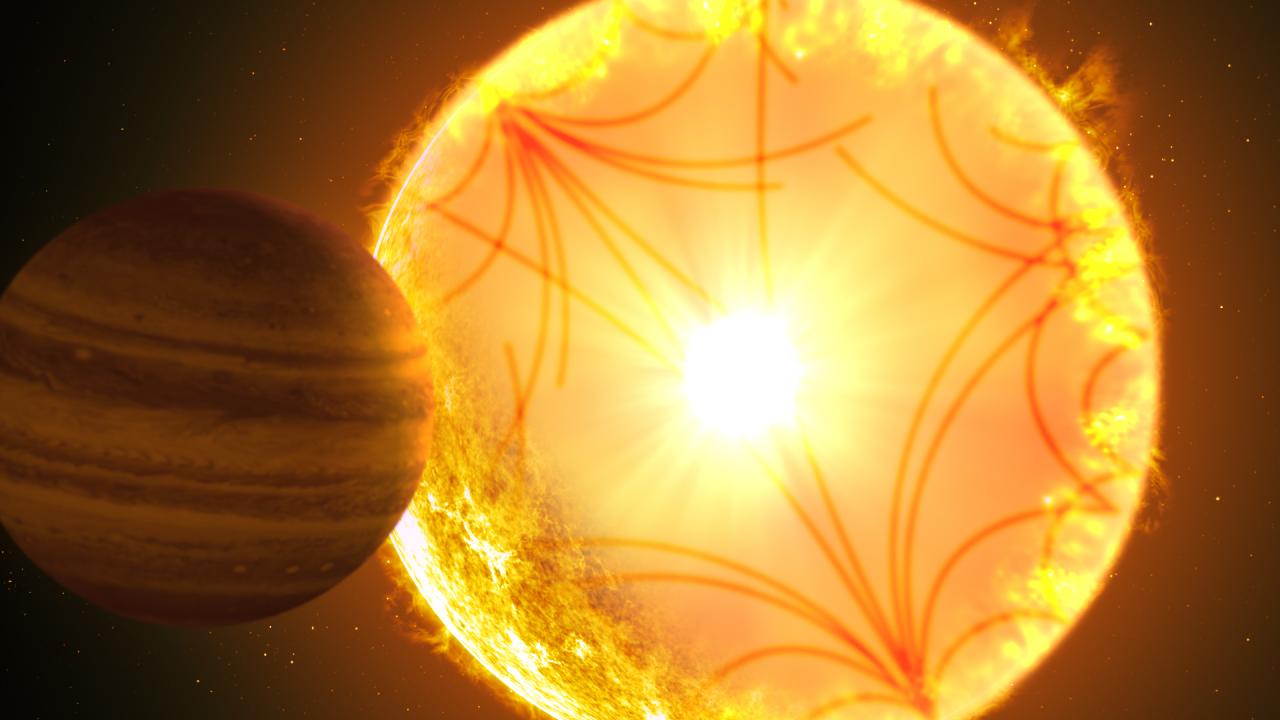
    The strategy of using planetary transits to discover new planets around other stars consists of the photometric detection of the dimming of the light of the star when one of its planets passes, or ‘transits’ in front of it. Currently this method is the preferred one for the study of small planets, not only due to its sensitivity, but also because this method allows a more detailed investigation of the planets found (e.g. Planetary atmospheres). This technique is similar to the one that is used for helio- and asteroseismology and so some of its methods are a logical extension from that. However, it is also important to develop new algorithms and observing methods for the unequivocal detection and analysis of planets and to be able to distinguish them from false alarms.

    The current horizon for studies of exoplanets with space missions involves new missions, beginning with the launch of CHEOPS, followed by TESS, JWST and in 2026, PLATO. Thus, there is presently a window of opportunity for ground-based facilities, and we are pursuing observations using mainly TNG, NOT y GTC.

    Principal investigator

    Milestones

    1. Beck et al. (2024, A&A, 682, A7) increased the number of known solar-like oscillators in binary systems by about an order of magnitude. Such large sample allowed us to study the effects co-evolution of stellar evolution on the evolution of the binary orbits. Featured as "ESA Gaia image of the Week".
    2. Following the participation to the roadmaps in astrophysics for the ESA’s Human and Robotic Exploration Directorate in 2021, a paper in npj Microgravity was published where the key quetions in stellar physics were exposed along with proposed experiments for the future as part of that program (Mathur & Santos 2024).
    3. Merc et al. (2024, A&A, 683, A84) presented the first analysis of accretion-induced flickering variability in symbiotic binary stars from TESS lightcurves. This study significantly enlarged the known sample with such variability. This suggests that accretion disks are common in symbiotic stars.
    4. Solar magnetic activity in cycles 23&24 were analyzed by tracking GOLF low-degree p-mode frequency shifts across 3 bands, probing depths of 74–1575 km. Results suggest magnetic variations mainly occur near the surface. In cycle 24, shifts appeared earlier at high latitudes and coincided with surface activity near the equator, with stronger shifts at shallower depths.

    Related publications

    Solar-like oscillations in γ Cephei A as seen through SONG and TESS. A seismic study of γ Cephei A 2023A&A...675A.197K
    FX UMa: A New Heartbeat Binary System with Linear and Nonlinear Tidal Oscillations and δ Sct Pulsations 2023AJ....166...42W
    The breakdown of current gyrochronology as evidenced by old coeval stars 2023MNRAS.523.5947S
    Pyodine: an open, flexible reduction software for iodine-calibrated precise radial velocities 2023A&A...674A.164H
    TOI-733 b: A planet in the small-planet radius valley orbiting a Sun-like star 2023A&A...674A.117G
    Multi-campaign asteroseismic analysis of eight solar-like pulsating stars observed by the K2 mission 2023A&A...674A.106G
    TOI-5678b: A 48-day transiting Neptune-mass planet characterized with CHEOPS and HARPS★ 2023A&A...674A..43U
    Refined parameters of the HD 22946 planetary system and the true orbital period of planet d★ 2023A&A...674A..44G
    TESS and CHEOPS discover two warm sub-Neptunes transiting the bright K-dwarf HD 15906 2023MNRAS.523.3090T
    Two warm Neptunes transiting HIP 9618 revealed by TESS and Cheops 2023MNRAS.523.3069O
    A new dynamical modeling of the WASP-47 system with CHEOPS observations 2023A&A...673A..42N
    Revisiting the Red Giant Branch Hosts KOI-3886 and ι Draconis. Detailed Asteroseismic Modeling and Consolidated Stellar Parameters 2023AJ....165..214C
    Temporal variation of the photometric magnetic activity for the Sun and Kepler solar-like stars 2023A&A...672A..56S
    A super-Earth and a mini-Neptune near the 2:1 MMR straddling the radius valley around the nearby mid-M dwarf TOI-2096 2023A&A...672A..70P
    The geometric albedo of the hot Jupiter HD 189733b measured with CHEOPS 2023A&A...672A..24K
    Glancing through the debris disk: Photometric analysis of DE Boo with CHEOPS 2023A&A...671A.127B
    A full transit of v<SUP>2</SUP> Lupi d and the search for an exomoon in its Hill sphere with CHEOPS 2023A&A...671A.154E
    TOI-836: A super-Earth and mini-Neptune transiting a nearby K-dwarf 2023MNRAS.520.3649H
    TOI-1055 b: Neptunian planet characterised with HARPS, TESS, and CHEOPS 2023A&A...671L...8B
    Hint of an exocomet transit in the CHEOPS light curve of HD 172555 2023A&A...671A..25K
    TESS Asteroseismic Analysis of HD 76920: The Giant Star Hosting an Extremely Eccentric Exoplanet 2023ApJ...945...20J
    Rotational modulation in A and F stars: magnetic stellar spots or convective core rotation? 2023MNRAS.520..216H
    Connecting photometric and spectroscopic granulation signals with CHEOPS and ESPRESSO 2023A&A...670A..24S
    Examining the orbital decay targets KELT-9 b, KELT-16 b, and WASP-4b, and the transit-timing variations of HD 97658 b 2023A&A...669A.124H
    Radial velocity confirmation of a hot super-Neptune discovered by TESS with a warm Saturn-mass companion 2023MNRAS.519.5637K
    55 Cancri e's occultation captured with CHEOPS 2023A&A...669A..64D
    The EBLM project - IX. Five fully convective M-dwarfs, precisely measured with CHEOPS and TESS light curves 2023MNRAS.519.3546S
    Discovery of TOI-1260d and the characterization of the multiplanet system 2023MNRAS.519.1437L
    HD 20329b: An ultra-short-period planet around a solar-type star found by TESS 2022A&A...668A.158M
    On the Characterization of GJ 504: A Magnetically Active Planet-host Star Observed by the Transiting Exoplanet Survey Satellite (TESS) 2022ApJ...940...93D
    Spinning up the Surface: Evidence for Planetary Engulfment or Unexpected Angular Momentum Transport? 2022ApJ...940...23T
    Hunting for anti-solar differentially rotating stars using the Rossby number. An application to the Kepler field 2022A&A...667A..50N
    TOI-2196 b: Rare planet in the hot Neptune desert transiting a G-type star 2022A&A...666A.184P
    Precise mass determination for the keystone sub-Neptune planet transiting the mid-type M dwarf G 9-40 2022A&A...666A.154L
    Confirmation and characterisation of three giant planets detected by TESS from the FIES/NOT and Tull/McDonald spectrographs 2022A&A...667A..22K
    99 oscillating red-giant stars in binary systems with NASA TESS and NASA Kepler identified from the SB9-Catalogue 2022A&A...667A..31B
    A 4 Gyr M-dwarf Gyrochrone from CFHT/MegaPrime Monitoring of the Open Cluster M67 2022ApJ...938..118D
    SPECULOOS Northern Observatory: Searching for Red Worlds in the Northern Skies 2022PASP..134j5001B
    Solar-like oscillations and ellipsoidal variations in TESS observations of the binary 12 Boötis 2022MNRAS.516.3709B
    Sub-stellar companions of intermediate-mass stars with CoRoT: CoRoT-34b, CoRoT-35b, and CoRoT-36b 2022MNRAS.516..636S