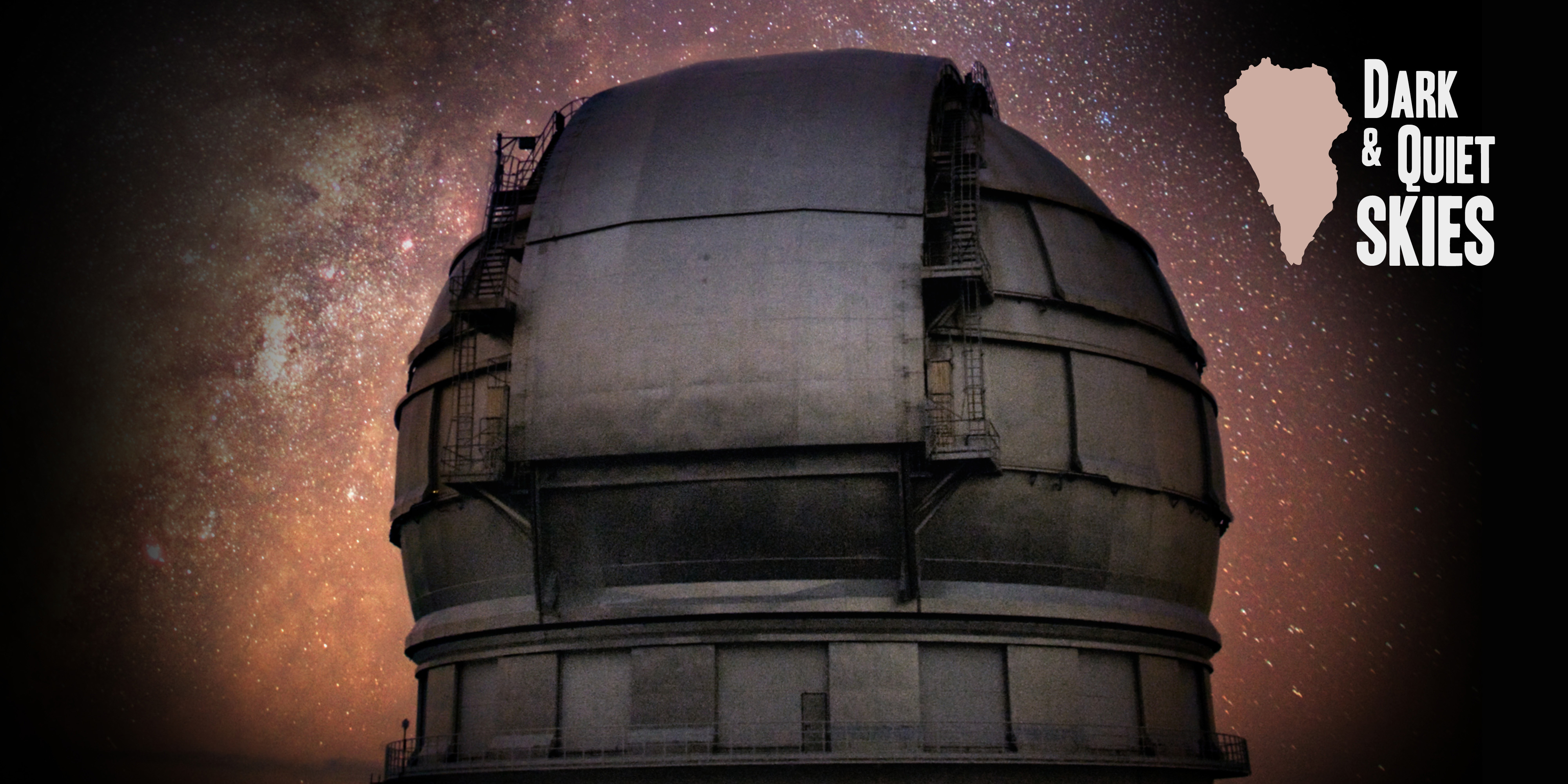
OGS TELESCOPE (OPTICAL GROUND STATION) |
The Optical Ground Station (OGS), installed in the Teide observatory 2400 above the sea level, was built as part of ESA long term efforts for research in the field of inter-satellite optical communications. The original purpose of the station, equipped with a telescope (1m aperture), is to perform the in-orbit test of laser telecommunications terminals on board of satellites in Low Earth Orbit and Geostationary Orbit. Since 2001, the ESA survey of Space Debris in the Geostationary Orbit and the Geostationary Transfer Orbit is also being carried out with a devoted wide field camera attached to the Ritchey-Chretien focus. Furthermore, approximately a third of the observing time is used for basic astronomical research from ESA and IAC science teams with dedicated instruments either in the Coudé or in the Ritchey-Chrétien foci. The Optical Ground Station was inaugurated in 1995. The Instituto de Astrofísica de Canarias participated in the integration of the station instruments and has since then been in charge of the station operation. Since January 2001, ESA-ESOC has been carrying out periodic survey campaigns of the space debris in GEO and GTO. This is the contribution of ESA to the worldwide common efforts on this task with NASA and NASDA (National Aerospace and Defense Agency of Japan). Since November 2001, the bidirectional link with GEO satellite ARTEMIS has been established in more than 100 successful sessions. This is in practice the first world stable free optical laser link ground-satellite. The purpose of this programme is the analysis of the effect of atmospheric turbulence on optical communications performance between ground stations and satellites in the geostationary orbit. Since 2002, a sodium Laser Guide Star has been implemented by IAC in order to analyse the short/long term variation of the height, width and density of the sodium mesospheric layer. In September 2003, it was performed the validation test of the LUCE optical terminal, the optical payload of OICETS satellite, launched in 2005 by NASDA. |
The OGS telescope may work in three different configurations, each one with its own secondary mirror: the basic Ritchey-Chrétien system, the modified Ritchey-Chrétien system with focal reducer and the Coudé system. |
| CONFIGURATIONS | |
| Basic Ritchey-Chrétien, focal ratio of 13,3, small field of view, for some scientific astronomical observations. | |
| Coudé, focal ratio of 38,95, for the communications tests with the Artemis satellite, using an infrared laser. | |
| Modified Ritchey-Chrétien, reduced focal ratio of reducida de 4,5 and large field of view (0,7x0,7 degrees). | |
| FEATURES | |
High pointing velocity (of up to two degrees per second, with maximum acceleration of 0.5 degrees/s2). |
|
High pointing precision (the average error in all possible telescope orientations is less than 10 arcseconds). |
|
High tracking precision (average error of 2.5 arcseconds per hour). |
|
The launching optical system of the communications equipment consists of a 25 W Ion Argon laser to pump a titanium:sapphire laser tunable from 760 to 890 nm (6W). The beam is divided into four sub-apertures in order to mitigate the effect of turbulence in the uplink. The receiving box of the communications system is equipped with a spectrometer, a polarimeter, an avalanche photodiode feeding a Bit Error Rate analyzer, and a Pointing, Acquisition and Tracking system in closed loop. The LGS is generated with a dye laser tunable in the sodium D2 line (1.5 W). |
Last updated : 12.02.2009 |