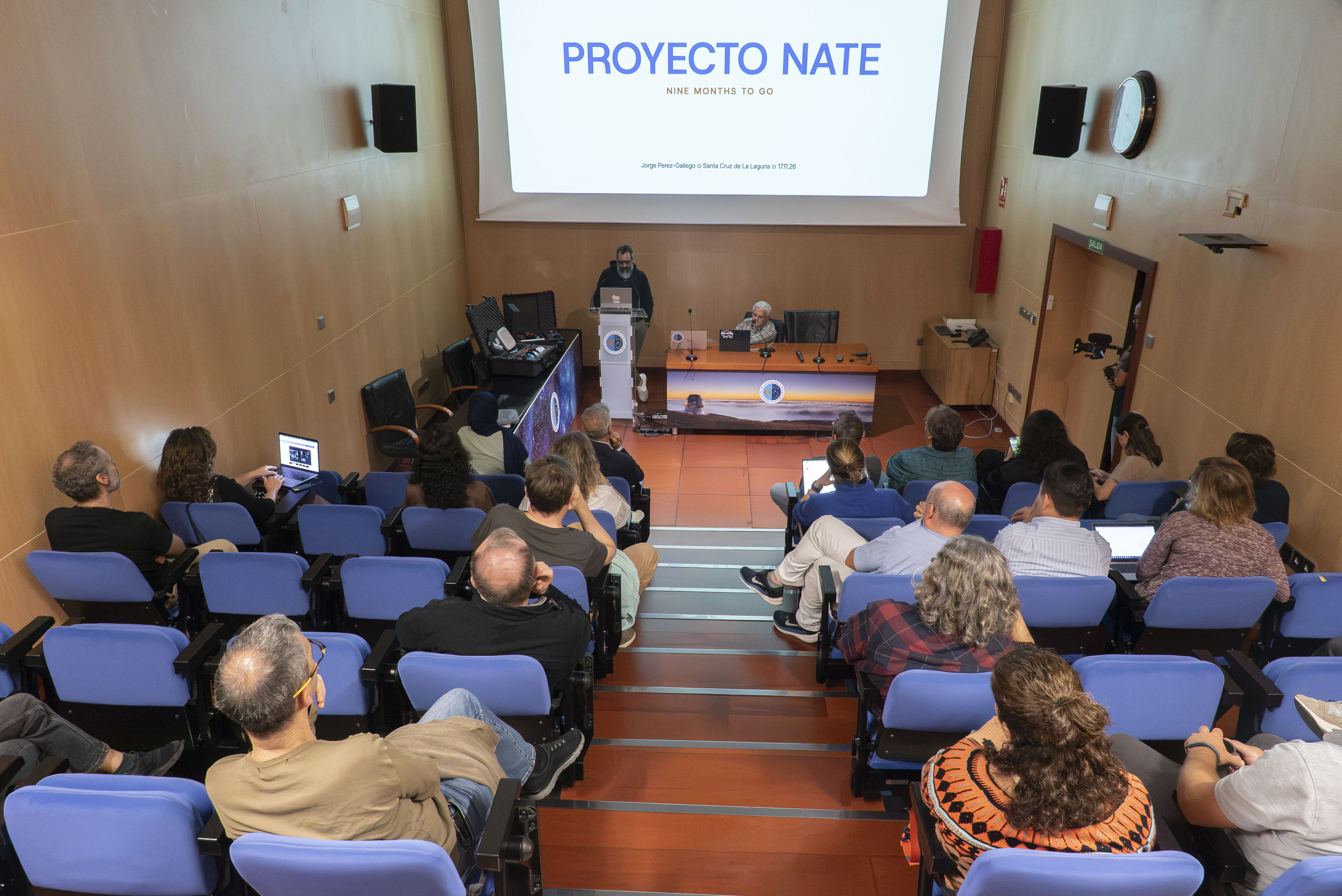
On November 17, the Canary Islands Institute of Astrophysics (IAC) hosted a working meeting of the NATE (North Africa Telescope Eclipse) team, during which it also shared with all staff the results of the training conducted in Palencia in preparation for the total solar eclipse on August 12. The meeting also allowed for progress to be made on preparations for the second—and main—phase of the project, which will take place in Morocco in conjunction with the total solar eclipse on August 2, 2027.
The event began with remarks by Valentín Martínez Pillet, director of the IAC, who summarized the results obtained in Palencia, outlined the current status of the project—including the outreach event held in Morocco under the auspices of the Education Office of the Spanish Embassy last October—and detailed the next steps to be taken. This information was then supplemented by NATE’s project manager, Jorge Pérez-Gallego.
Alfred Rosenberg, an IAC astrophysicist and science communicator, reported on the latest developments regarding the equipment that will be used by the project’s various stations, based on what was learned during the valuable experience in Palencia. For her part, Verónica Martín, head of the IAC’s Unit for Scientific Communication and Culture (UC3), highlighted the success—both in terms of outreach and communication—of the work carried out during the eclipse on August 2.
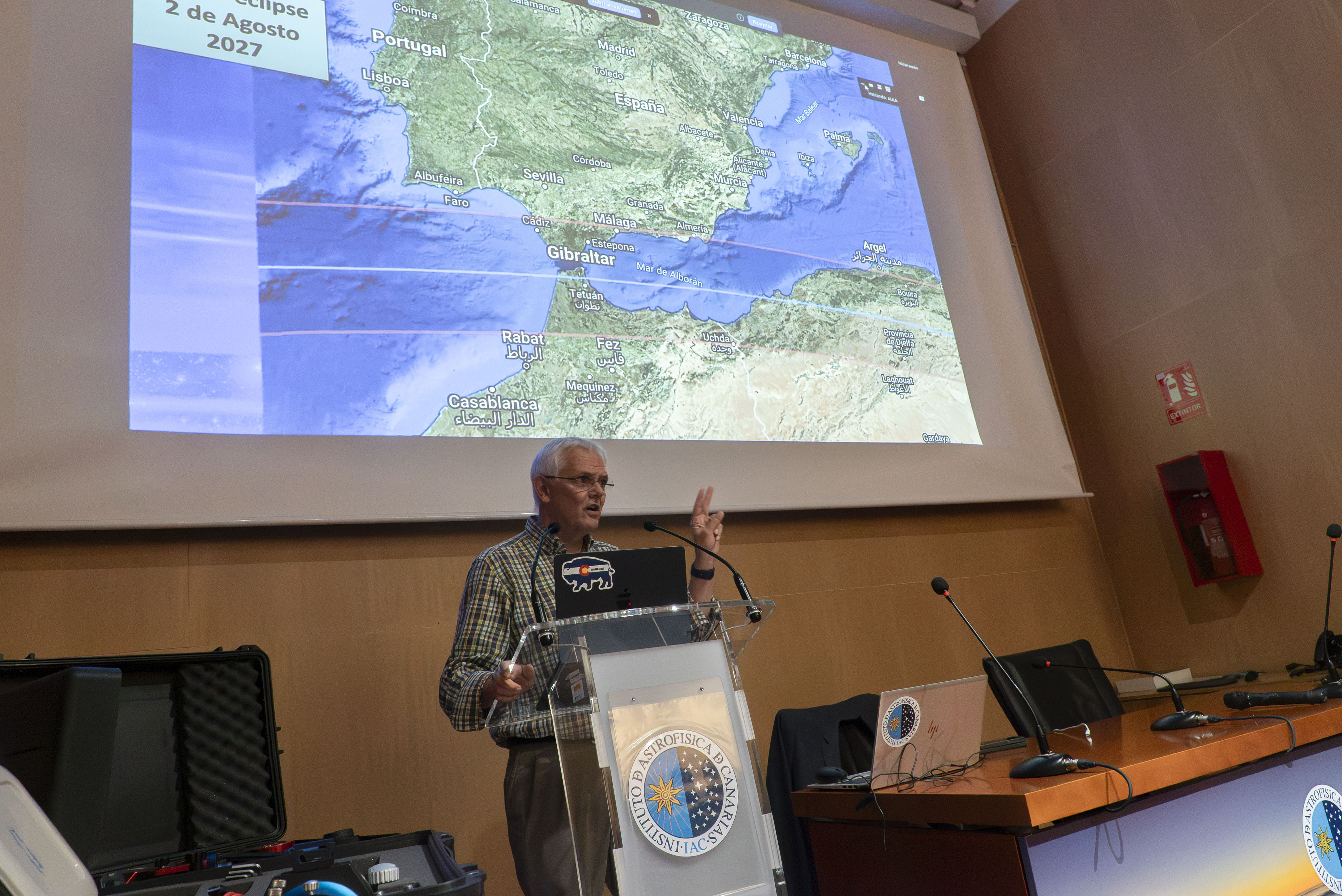
Practical Test
In closing, Nayra Rodríguez, an astrophysicist and science communicator at the IAC, spoke about the selection process for the various teams of faculty and students who will travel to Morocco to collect data. She was joined by Montserrat Delgado Cabrera, coordinator of the Canary Islands Government’s Department for the Promotion of Scientific Vocations and Creativity (STEAM). Javier Franco Hormiga, director of the Canary Islands Government’s Agency for Research, Innovation, and the Information Society (ACIISI), also spoke from the audience, expressing the regional government’s support for the project.
The program concluded with a hands-on demonstration of the equipment in the IAC’s Patio de los Naranjos and a get-together where all the participants were able to share their ideas and expectations for the coming months leading up to this summer’s big event.
The NATE Project
The NATE (North African Telescope Eclipse) project is led by the Canary Islands Institute of Astrophysics (IAC) in collaboration with Mohammed VI Polytechnic University (UM6P) in Morocco and the National Solar Observatory (NSO) of the U.S. National Science Foundation (NSF), and is supported by the Government of the Canary Islands. This is a science, education, and outreach initiative that will study the eclipse on August 2, 2027—visible in the southern tip of Spain, North Africa, and the Middle East—using a coordinated network of telescopes operated by teams composed of astronomers from the IAC and its partners, volunteers, teachers, high school students, and college students.
This initiative is inspired by the successful Citizen CATE (Continental American Telescopic Eclipse) experiments conducted in the U.S. during the 2017 and 2024 eclipses by the NSF, the NSO, and the Southwest Research Institute (SwRI). As the Moon’s shadow traverses the path of totality, teams located at various sites along this path will capture images of the brightness of the solar corona, extending the total duration of the observation to ten minutes. Coinciding with this event and in the days leading up to it, a comprehensive outreach program will capitalize on the interest generated by this type of event to foster an interest in science and, specifically, in astrophysics.
On August 2, 2026, during the first of the eclipses scheduled for the 2026–2028 period, and in collaboration with the city councils of Palencia and Frómista, the teams underwent training in the capital of Palencia. The experience proved to be a success in terms of public outreach and highly promising from a scientific standpoint, boding well for next year’s event.