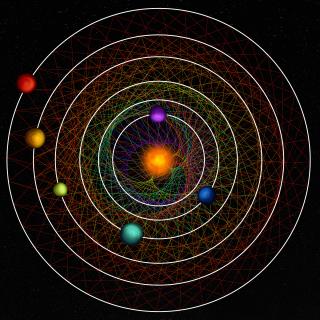
An international collaboration, with participation by the Instituto de Astrofísica de Canarias (IAC), has found a system of six exoplanets orbiting a central star with a precise rhythm.This phenomenon, known as orbital resonance, is common during the starting phase of planet formation, but it is exceptional to find a system with such a large set of planets which conserves this kind of gravitational synchronism. This finding shows that the system has not undergone major changes during its six billion year history, so that it gives an unusual view of the formation and evolution of planets. The
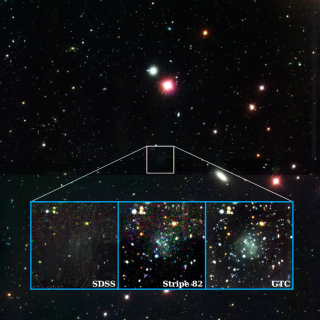
A group of astrophysicists led by Mireia Montes, a researcher at the Instituto de Astrofísica de Canarias (IAC), has discovered the largest and most diffuse galaxy recorded until now. The study has been published in the journal Astronomy & Astrophysics, and has used data taken with the Gran Telescopio Canarias (GTC) and the Green Bank Radiotelescope (GBT). Nube is an almost invisible dwarf galaxy discovered by an international research team led by the Instituto de Astrofísica de Canarias (IAC) in collaboration with the University of La Laguna (ULL) and other institutions. The name was
The first Canary Earth Observation Satellite, belonging to the Instituto de Astrofísica de Canarias (IAC), has successfully passed all the pre-launch technical tests, and is on the way to the United States for launch from California before the end of the year. ALISIO-1 ( Advanced Land-Imaging Satellite for Infrared Observations) is the first Canary satellite which will orbit the Earth, in the framework of the ALISIO space programme, led by the IAC and coordinated by the IACTEC-Space group. In 2018, the team gained its first success after the launch of an atmospheric sounding balloon with