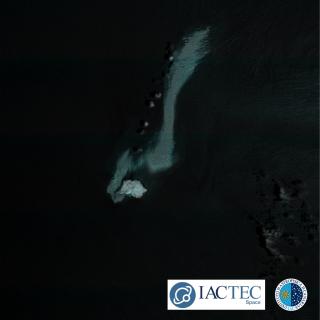
The observation, carried out with the DRAGO-2 infrared camera, demonstrates the capability of technology developed by the IAC in the Canary Islands to detect and monitor hydrocarbon spills in the ocean The ALISIO-1 satellite, the first space mission of the Instituto de Astrofísica de Canarias (IAC), has captured an oil slick associated with the tanker Caroline Bezengi, which is grounded near the Omani island of Al Qibiliya, in the Al Hallaniyat archipelago, in the Arabian Sea. The image, obtained on 22 September with the DRAGO-2 infrared camera, makes it possible to distinguish the extent of
El Instituto de Astrofísica de Canarias (IAC) celebra en 2026 la octava edición consecutiva del proyecto Habla con Ellas: Mujeres en Astronomía, una iniciativa de divulgación científica y educación en astronomía que se desarrolla en el marco del Día Internacional de la Mujer y la Niña en la Ciencia (11 de febrero). Dirigido a la comunidad educativa, el proyecto tiene como objetivo visibilizar el papel de las mujeres en la astronomía y la astrofísica, crear referentes femeninos en ciencia y tecnología e inspirar vocaciones científicas, especialmente entre niñas y jóvenes interesadas en las
A multidisciplinary team of astrophysicists, neuroscientists, engineers, and musicians has unveiled a pioneering method to “listen” to the structure of the human brain. Published in Nature Scientific Reports , the study presents the first higher-order sonification applied to structural magnetic resonance imaging (MRI) data. This technique involves transforming three-dimensional information about the brain into sound, taking into account the spatial relationships and complex structure of the data. To do this, mathematical tools originally developed to study the large-scale structure of the