The general picture of galaxy growth is that of a slow and steady process. Scientific consensus has concluded that gas accumulates in their disks, which triggers star formation and causes the galaxy to expand continuously over billions of years. However, a new study authored by researchers at the Instituto de Astrofísica de Canarias (IAC) challenges this view, at least for some galaxies.
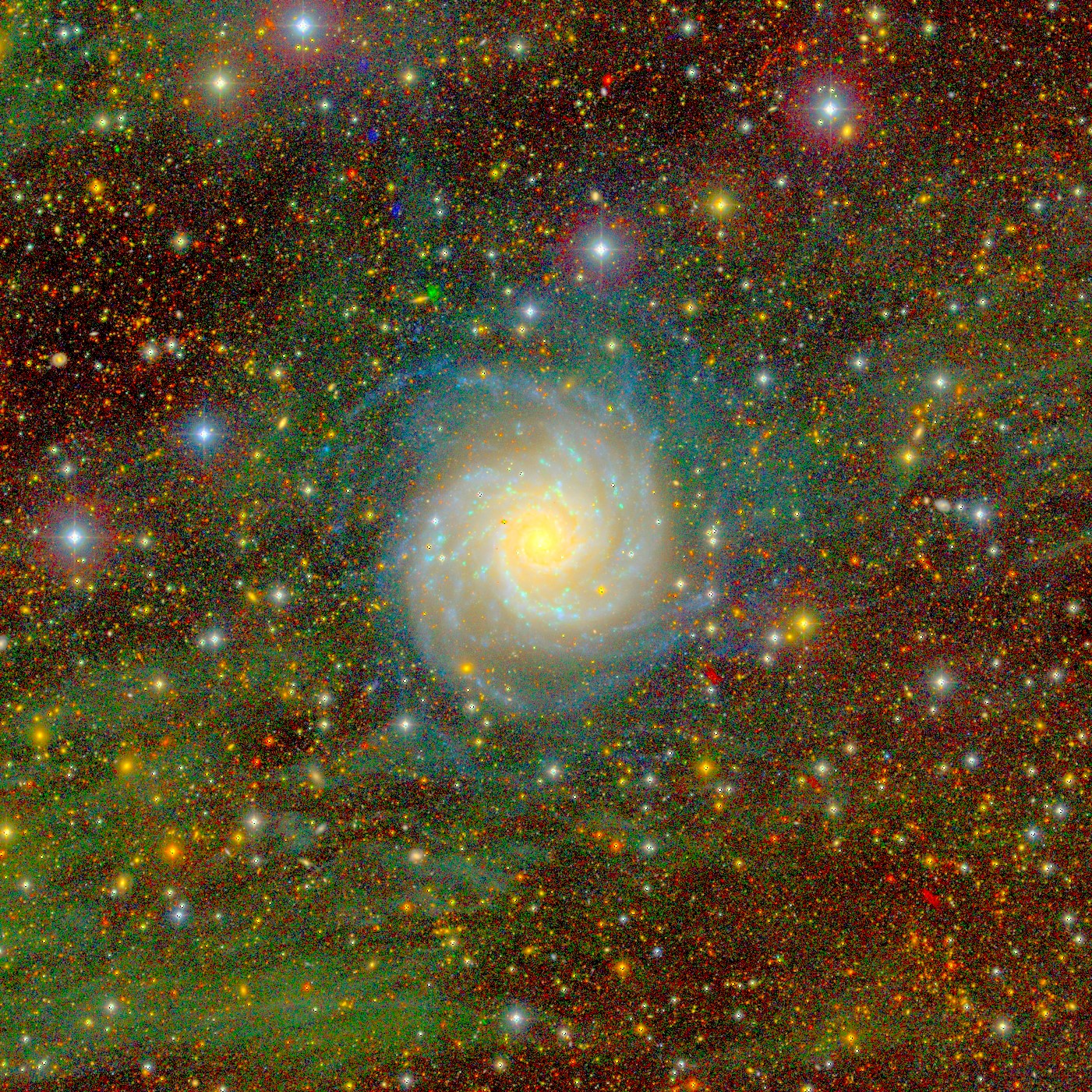
This research used data from the new Transient Survey Telescope (TST) at the Observatorio del Teide (Tenerife) to discover that the spiral galaxy Messier 74 (M74), one of the most studied in the sky, hides a massive disk of young stars in its outermost regions, doubling the known size of the galaxy in less than a billion years, a very brief period in astronomical terms.
“We have found that M74 has an extremely faint and blue outer disk that no one had seen before, despite this galaxy having been observed for decades”, explains Ignacio Ruiz, IAC´s researcher and first author of the study. “What is most surprising is the speed with which it has formed: in less than a billion years, a new disk of stars has emerged, extending the galaxy out to nearly 100,000 light-years from its center, double what we previously knew”, adds Ruiz.
Conventional images of M74 showed a disk of stars extending out to about 45,000 light-years from the center, similar to the Milky Way. However, the new observations, about ten times deeper than major catalogs known for decades, such as the famous SDSS, reveal a very different reality. Surrounding the known disk appears a structure of very young, intensely blue, and extremely faint stars that extends up to 100,000 light-years. This new component, barely perceptible in other observations, contains stars with an average age of just 640 million years, a tiny fraction of the galaxy's lifespan.
“Detecting such a faint structure requires an observation and data analysis strategy that is ‘friendly’ to these structures. The data available until now for this galaxy were neither deep enough to detect this structure nor had they been analyzed following a strategy focused on preserving these kinds of faint regions”, explains Ignacio Trujillo, IAC´s researcher and co-author of the study.
The culprit: an annoying neighbor
How can a galaxy grow so fast? The team points to a violent episode in M74’s recent past: the close passage of the neighboring galaxy UGC 1176, located about 400,000 light-years from M74. These types of encounters, known as flybys, can destabilize the cold gas surrounding a galaxy and cause it to start forming stars in its outermost regions.
“If UGC 1176 passed close to M74 about a billion years ago, it would have shaken the gas in the outer disk and triggered star formation throughout that región”, explains Ignacio Trujillo. “The stars we see now in the outer disk are the fingerprint of that encounter. M74 is, in a sense, still digesting that collision”.
This scenario is consistent with the available data: the cold gas (composed of neutral hydrogen) in M74 extends far beyond the previously known stellar disk. Furthermore, it presents asymmetries and complex structures that for decades puzzled astronomers and now find a natural explanation as a consequence of that past interaction.
A new telescope, a new window to the faintest Universe
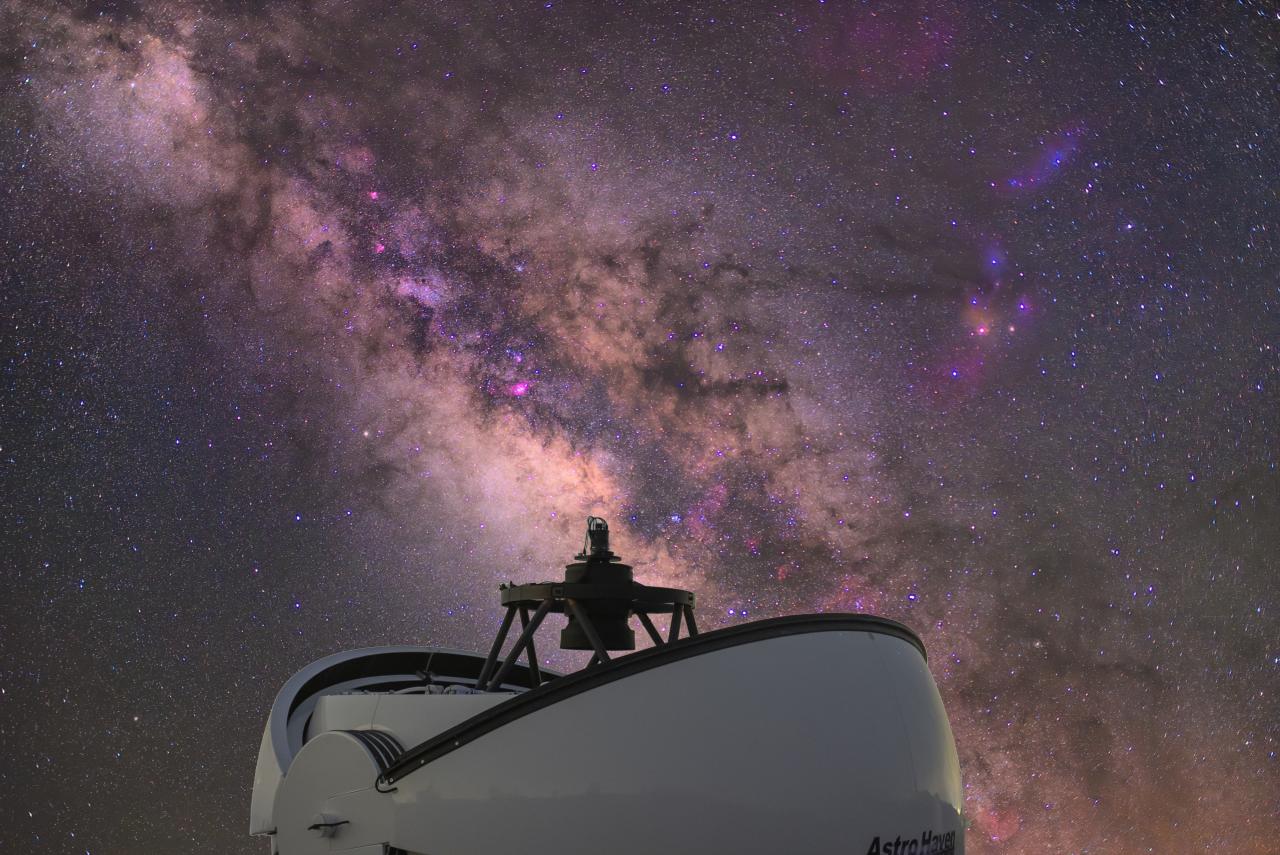
The discovery was made possible thanks to the new Transient Survey Telescope (TST), a robotic telescope with a one-meter aperture installed at the Teide Observatory and operated by the Canarian company LightBridges. Despite its modest size, the combination of its wide-field camera with an observation and image-processing strategy designed to preserve the faintest structures allows it to reach depths impossible for conventional larger-aperture telescopes.
“This shows that with the right instrumentation and careful data reduction, a one-meter telescope can reveal structures that escape much more powerful telescopes”, notes Miquel Serra-Ricart, co-author of the study and technical head of the observations.
This study brings a new perspective to current models of galaxy growth and evolution. The case of M74 suggests that this process can be interrupted or dramatically accelerated by encounters with other galaxies, producing episodes of almost instantaneous growth in astronomical terms.
“What we see in M74 might not be exceptional”, warns Trujillo, adding that “it is possible that many galaxies go through similar episodes of explosive growth that we simply haven't been able to detect until now because the images were not deep enough. The study of more galaxies with the TST in the northern hemisphere, or the arrival of new instruments like the Vera Rubin Telescope in Chile exploring the southern hemisphere, could reveal whether this phenomenon is much more common than we think”.
IAC's contact: Ignacio Ruiz: ignacio.ruiz [at] iac.es (ignacio[dot]ruiz[at]iac[dot]es)