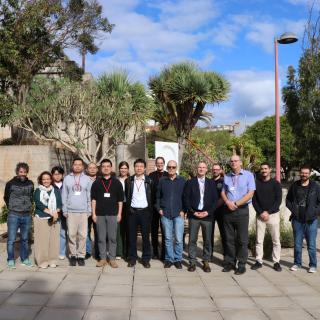

The Instituto de Astrofísica de Canarias is taking part in the 41st edition of the leading international space forum, held in Colorado Springs from 13 to 16 April, within the Spain Pavilion organised by ICEX alongside 16 other organisations from the sector.
The Instituto de Astrofísica de Canarias (IAC), through IACTEC Space, its department dedicated to the development of technology for small satellites, took part this week in Space Symposium 2026, held in Colorado Springs, Colorado, USA, from 13 to 16 April. The event, organised by the Space Foundation and now in its 41st edition, is the benchmark forum for the global space industry, with more than 10,000 attendees from over 40 countries at its latest edition.
The IAC has been part of the Spain Pavilion, organised by ICEX and the Economic and Commercial Office of Spain in Los Angeles under the Spain Space brand. In this edition, the pavilion has brought together 17 Spanish organisations (a record level of participation) and has showcased the full value chain of Spain’s space sector to stakeholders such as NASA, NOAA, Lockheed Martin, Boeing, Northrop Grumman and SpaceX. The IAC delegation was made up of Valentín Martínez Pillet, Director of the IAC, and part of the IACTEC Space team: Álex Oscoz, Head of Department; José Alonso Burgal, Manager; and Alfonso Iñigo Rivera, Systems Engineer.
Projects presented at the event
During the event, IACTEC Space presented its main developments and ongoing initiatives. These included IACSAT-1, the IAC’s first space astronomical observatory, focused on the study of exoplanets and asteroids; ALISIO-1, the first Canary Islands Earth observation satellite, in orbit since December 2023; and the Canary Islands Constellation (CIC), a project involving the deployment of an Earth observation satellite constellation with a delivery schedule running until 2028, whose official kick-off was recently held at IACTEC facilities.
The family of DRAGO space cameras was also presented, in its DRAGO-1, DRAGO-2 and DRAGO-3 versions, a line of compact SWIR (short-wave infrared) instrumentation for Earth observation. DRAGO-3, currently under development and scheduled for launch in 2027, expands the series’ spectral and resolution capabilities.
These developments fall within the IAC’s technology transfer model, which combines astrophysical research with the design and validation of space instrumentation. The Institute holds patented technology in this field, such as the dark current correction method for uncooled cameras, which has been validated in real space missions and is available for licensing.
Collaboration agreement with the Laboratory for Atmospheric and Space Physics
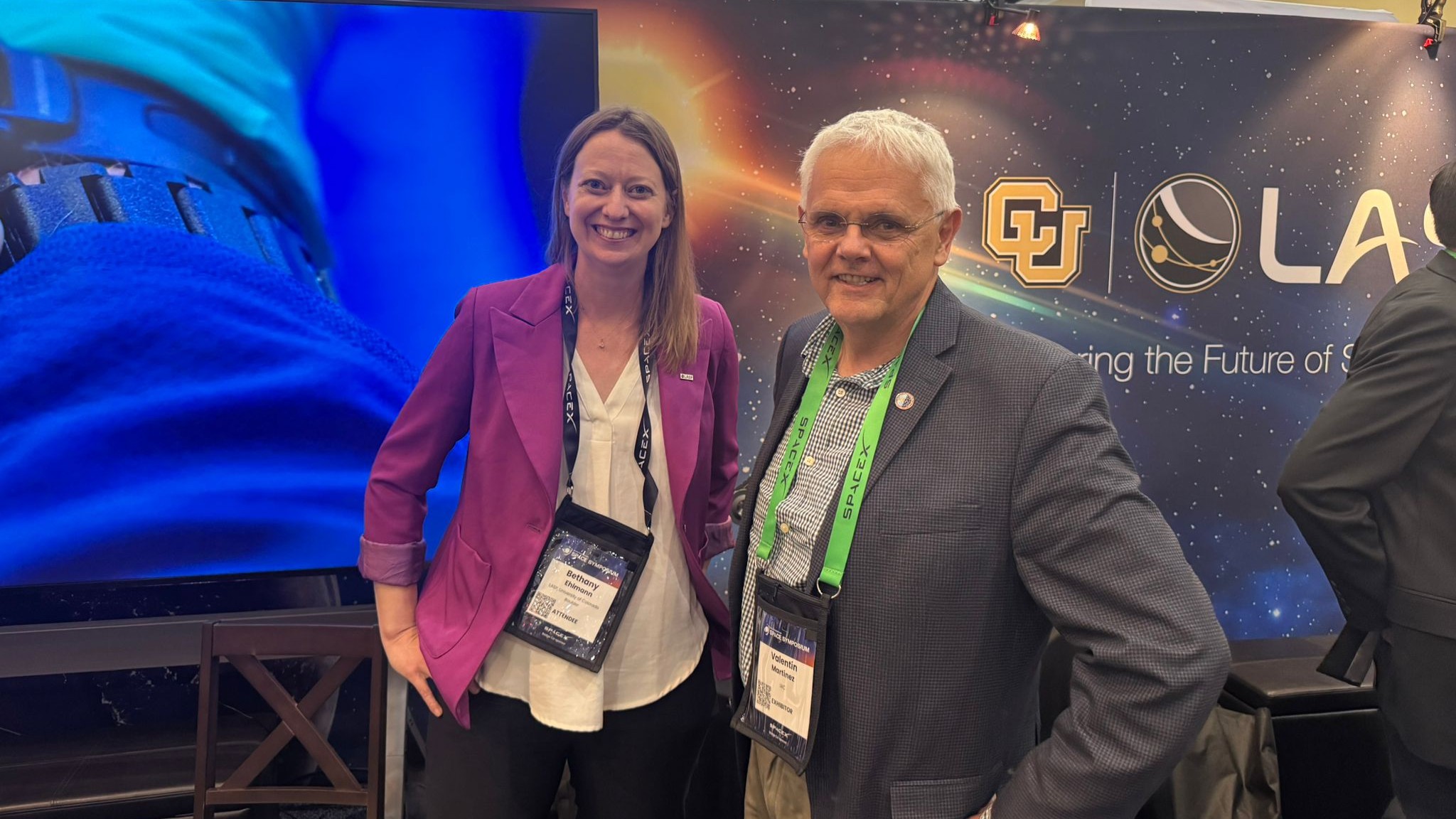
As part of the Space Symposium, the IAC signed a memorandum of understanding (MoU) with the Laboratory for Atmospheric and Space Physics (LASP) at the University of Colorado Boulder. The agreement, signed by Valentín Martínez Pillet and Bethany Ehlmann, Director of LASP, establishes a framework for collaboration in areas such as space development, optics, space weather and staff mobility between the two institutions.
Founded in 1948, LASP is one of the world’s leading university-based space centres. It is part of the University of Colorado Boulder, the public university that receives the highest volume of NASA research grants in the United States, and has developed the ability to combine space science with hardware design, integration and validation, as well as mission operations and data management. With more than a dozen flight programmes under development at the same time and experience in operating more than 100 space instruments, LASP is known in the sector as the “university NASA” for its technical capability and institutional independence.
“LASP represents exactly the kind of partner the IAC needs to take the next step in its space development,” says Valentín Martínez Pillet, Director of the IAC. “It is a university laboratory that operates with the discipline and scale of an agency, and that makes it a benchmark for any institution that wants to do space science and engineering at the same time. This agreement opens up a genuine avenue for collaboration in technology, space science and training people.”
The collaboration agreement is the first of this scope between the IAC and a leading academic space institution in the United States, and strengthens the international profile of the Institute at a time when IACTEC Space is consolidating its activity with ongoing missions, awarded projects and technology validated in orbit.
The activities of IACTEC Space are developed within the framework of the CELESTE project, which channels the activity of the IAC’s Space Department and its commitment to the development of advanced space technology from the Canary Islands.