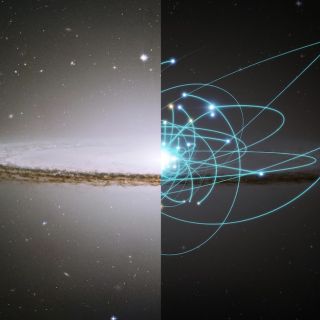
An artist’s impression of the distribution and arrangement of stars in the Milky Way’s disc. Credit: Gabriel Pérez, SMM and Gaia.
An international team, led by a pre-doctoral researcher at the Instituto de Astrofísica de Canarias (IAC), has discovered with great precision how the Milky Way’s disc became flattened. Using data from the Gaia satellite and thanks to the precise ages derived by the ChronoGal project, the researchers have identified two stages: a very rapid thinning that ended around 10.8 billion years ago, and a much slower process that continues to the present day. The study is published in The Astrophysical Journal Letters.
Most of the stars in the Milky Way are distributed across two discs: a thin, young one, and a thicker, older one. How they formed has been one of the major problems in galactic astrophysics. Until now, observations were consistent with two explanations. In the first, stars are always born in a thin disc and, over time, encounters with gas clouds, spiral arms or the galactic bar ‘shake them up’ and push them away from the plane. In the second, stars form in increasingly thin distributions because the gas from which they form gradually settles. Distinguishing between the two required knowing the stars’ ages precisely, something very difficult to achieve, especially for the oldest ones.
The study, published in The Astrophysical Journal Letters, shows that the younger the stars are, the closer they are to the plane, but not at a constant rate. There is a turning point around 10.8 billion years ago. Before that, the disc flattened very rapidly; in just 2,000 million years, its thickness went from over 4,100 light-years (1.26 kpc) to around 1,600 light-years (0.5 kpc). Afterwards, the thinning was very gradual, until the disc reached a thickness of around 400 light-years (0.1 kpc) for the newly formed stars.
If stars were always born in a thin disc and gradually moved away from the plane, the disc would have thickened slowly and continuously. The data show something different. Such a rapid change cannot be explained by a slow and gradual process, and even less so in a young galaxy that frequently collided with other galaxies. Instead, it fits with the model known as the ‘upside-down’ model: the disc does not form thin, but thick, because the gas from which stars form is highly turbulent, and it becomes thinner as that gas calms down and settles. According to the authors, the thick disc formed during that initial turbulent stage and the thin disc formed later, during a much calmer phase.
“This result resolves a classic problem in astrophysics,” says David Mirabal, a pre-doctoral researcher at the IAC and the ULL and lead author of the study. “In the simulations, both disc formation models were possible, but there was a lack of observational evidence to determine which one occurred in the Milky Way. This is the first clear observational evidence favouring one of the two models for the Galaxy’s early stage. And it has been possible thanks to the high precision we achieved for the older ages,” he emphasises.
This discovery has been made possible by Gaia, the European Space Agency (ESA) mission that has measured the position, motion and brightness of over a billion stars, and by the ChronoGal project, funded by the European Research Council and led by the IAC. ChronoGal provides ages with an accuracy of better than 5 per cent – a margin of error of around 500 million years even for the oldest stars – something that has been very difficult to achieve until now. The analysis made use of the IAC’s high-performance computing resources.
The study also involves researchers from the University of La Laguna (ULL), the University of Granada, the Instituto Carlos I de Física Teórica y Computacional, the Istituto Nazionale di Astrofisica (INAF, Observatorio Astronómico de Abruzzo), the Istituto Nazionale di Fisica Nucleare (INFN) and the University of Victoria (Canada). In addition to David Mirabal, the article is co-authored by IAC and ULL researchers Carme Gallart, Emma Fernández-Alvar, Anna B. A. Queiroz, Guillem Aznar-Menargues, Chris B. A. Brook and Pedro A. Palici.
This work has been funded by the State Research Agency of the Ministry of Science and Innovation (AEI-MCINN) through the project “At the forefront of Galactic Archaeology: evolution of the luminous and dark matter components of the Milky Way and Local Group dwarf galaxies in the Gaia era”, reference PID2023-150319NB-C21/10.13039/501100011033. It has also been funded through the project “At the forefront of Galactic Archaeology: the chemical aspect”, reference PID2023-150319NB-C22/10.13039/501100011033. The ChronoGal project receives funding from the European Research Council (ERC) through the ERC-2024-AdG project “ChronoGal: Chronology of our Galaxy from Gaia CMD-fitting” (grant agreement 101201412). |
Article: D. Mirabal, C. Gallart, T. Ruiz-Lara, E. Fernández-Alvar, A. B. A. Queiroz, et al., “A two-stage settling of the Milky Way disk revealed by precise ChronoGal ages”, The Astrophysical Journal Letters, 2026, DOI: https://doi.org/10.3847/2041-8213/aeb0a3
Contact at the IAC:
David Mirabal, david.mirabal [at] iac.es (david[dot]mirabal[at]iac[dot]es)