The Instituto de Astrofísica de Canarias (IAC), through its Communication and Scientific Culture Unit (UC3) and in collaboration with the Museum of Science and the Cosmos (MCC), part of Tenerife Museums, publishes the astronomical events for the year 2026 in its traditional calendar. The year 2026 will be marked by a total solar eclipse on 12 August, which will not be visible from the Canary Islands, but will be 70 per cent partial. In addition, 2026 will see the arrival of new comets, meteor showers and other interesting astronomical events.
The IAC's 2026 Calendar is illustrated with a photograph of comet C/2025 AB (Lemmon) taken from the Teide Observatory by astrophotographer Daniel López, from Cielos de Canarias, and IAC astrophysicist and science communicator Alfred Rosenberg.
This space traveller, a rock of ice and dust barely a kilometre in diameter, displayed a tail more than 30 million kilometres long, 20 times the size of our Sun. However, the photograph reveals another reality: a tangle of more than a thousand luminous trails belonging to the more than 13,000 satellites orbiting the Earth overlap the comet.
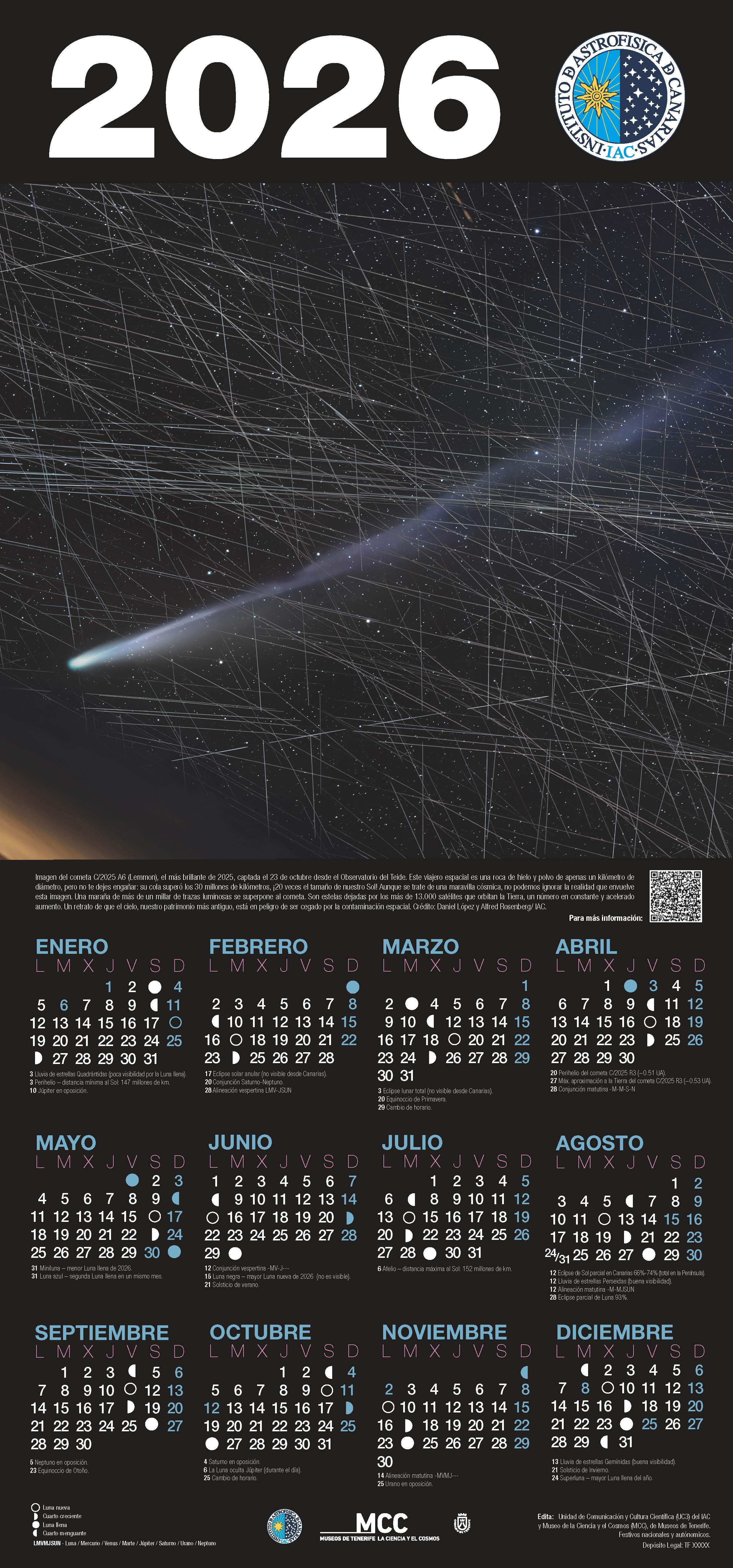
The year 2026 will offer unmissable events for astronomy enthusiasts. We begin the year with the Quadrantid meteor shower on 3 January, although on this occasion it will be difficult to see as it coincides with the full moon.
Among the most notable events is the solar eclipse on 12 August, which will be visible in the Canary Islands with a magnitude of between 66% and 74% and will be total in part of the Iberian Peninsula. The calendar also highlights unique phenomena such as the ‘Blue Moon’ on 31 May (the second full moon in the same month) and the ‘Black Moon’ on 15 June (the month with the smallest moon of the year). On 24 December, we will close the annual cycle with a ‘Supermoon’, which will be the largest full moon of 2026.
In terms of celestial mechanics, the year will begin with Earth's perihelion on 4 January, placing us 147 million kilometres from the Sun, while the aphelion will occur on 6 July at a distance of 152 million kilometres. The spring and autumn equinoxes will take place on 20 March and 23 September respectively, marking the seasonal changes along with the summer solstice (21 June) and winter solstice (21 December).
The planets will also play a leading role with various configurations: Jupiter will reach opposition on 10 January, Saturn on 4 October and Uranus on 25 November. Notable planetary alignments and conjunctions are also expected, notably the Saturn-Neptune conjunction on 20 February and various morning and evening alignments of Mercury, Venus, Mars, Jupiter and Saturn throughout March, May, August and November.
The tracking of minor bodies will be another point of interest, especially with the closest approach to Earth of comet C/2025 R3 on 27 April, following its perihelion on the 20th of the same month. Meteor showers will continue as usual, with the Perseids reaching their peak on 12 August and the Geminids on 13 December, both with good visibility conditions expected.
In short, 2026 looks set to be a good year for astronomical observation, with a packed calendar of events that will allow both professionals and enthusiasts to enjoy the riches of our sky. From the privileged skies of the Canary Islands, the IAC invites society to continue discovering the Universe and to preserve the darkness of our nights.