News

This section includes scientific and technological news from the IAC and its Observatories, as well as press releases on scientific and technological results, astronomical events, educational projects, outreach activities and institutional events.

Displaying 1 - 6 of 2954
Advertised on
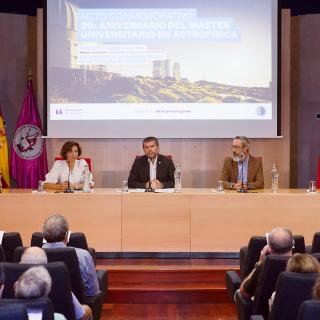
  • Acto de celebración del vigésimo aniversario del Máster en Astrofísica de la ULL
    El Departamento de Astrofísica de la Universidad de La Laguna celebra el vigésimo aniversario de su Máster en Astrofísica, una de las ofertas de posgrado más reconocidas de España en el ámbito de la Astrofísica y pionera en la implantación de los estudios oficiales de máster en la Universidad de La Laguna. Con motivo de este aniversario, el Aula Magna Blas Cabrera Felipe de la Facultad de Ciencias acogió un acto conmemorativo en el que se repasó la trayectoria de este programa, que durante las dos últimas décadas se ha convertido en un referente nacional e internacional en la formación de
    Advertised on
  • Collage showing the September 2026 cover of Astronomía magazine, pages from its UNDARK feature article, and science journalist Thomas Villa.
    The European project led by the Instituto de Astrofísica de Canarias (IAC) is featured on the cover of issue 327, the September 2026 edition of Astronomía magazine, with an extensive feature exploring the search for answers about the dark universe. We’re on the cover! And for UNDARK, this is a wonderful opportunity to bring some of the most fascinating questions in science today beyond laboratories and observatories and closer to society. Under the title “Shedding Light on the Dark Cosmos,” Astronomía dedicates its cover and an extensive eight-page feature to UNDARK ( Unravelling the Dark
    Advertised on
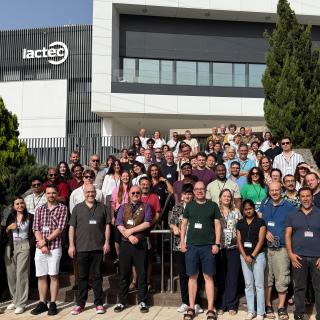
  • Participants at the COST NanoSpace Joint Scientific Meeting, held at the IACTEC building in La Laguna, Tenerife
    The Instituto de Astrofísica de Canarias (IAC) will host the Final COST NanoSpace Joint Scientific Meeting (CA21126) from 15 to 17 September (at the IACTEC facilities). The international meeting will bring together researchers and innovators from different disciplines to study carbon-based molecular nanostructures in space and explore their potential applications. The COST Action NanoSpace brings together researchers from 67 countries, along with several industrial partners. It promotes a multidisciplinary approach to advancing our understanding of the physics and chemistry of carbon
    Advertised on
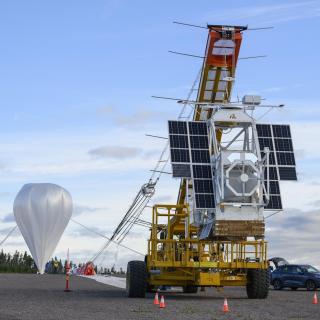
  • Momento del lanzamiento de Sunrise III
    El Instituto de Astrofísica de Canarias (IAC) y la Universidad de La Laguna ULL) y participan en la misión internacional Sunrise III, un observatorio solar estratosférico transportado por globo que permite estudiar la parte inferior de la atmósfera solar, desde la superficie del Sol hasta la cromosfera media, con una resolución espacial cercana a los 50 kilómetros sobre la superficie solar. En julio de 2024, Sunrise III completó con éxito un vuelo de casi una semana de duración, recorriendo la distancia que separa el norte de Suecia y el noroeste de Canadá, durante el cual recopiló alrededor
    Advertised on
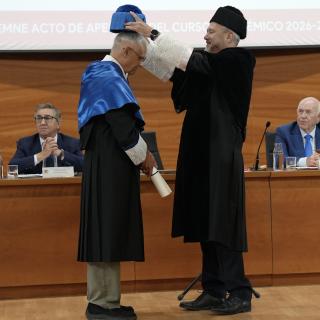
  • El astrofísico Valentín Martínez Pillet, director del IAC, siendo envestido Doctor Honoris por la UMH durante el acto de apertura del curso académico 2025/26
    La Universidad Miguel Hernández de Elche (UMH) ha investido Doctor Honoris Causa al director del Instituto de Astrofísica de Canarias (IAC), Valentín Martínez Pillet. El acto de investidura ha tenido lugar dentro de la sesión inaugural del curso académico de esta universidad, bajo la presidencia del rector de la institución, Juan José Ruiz Martínez. La madrina del nuevo Doctor Honoris Causa ha sido la profesora del Área de Matemática Aplicada de la UMH Mari Carmen Perea. Asimismo, durante el transcurso del acto institucional, la UMH ha rendido homenaje a su personal mediante la entrega de
    Advertised on
  • Laboratory optical setup showing the small multimode fibre encapsulated inside a white ferrule and used to experimentally verify the sensor’s behaviour.
    A team from the Instituto de Astrofísica de Canarias (IAC) has tested a new technique capable of rapidly identifying the distortions that light undergoes as it passes through Earth’s atmosphere. The development, carried out by the Laboratorio para la Innovación en Optomecánica (LIOM) within the framework of the CELESTE project, could in the future contribute to the creation of more compact and simpler adaptive optics systems to improve the quality of astronomical observations. The technology combines an optical fibre approximately one centimetre long with artificial intelligence techniques
    Advertised on