News

This section includes scientific and technological news from the IAC and its Observatories, as well as press releases on scientific and technological results, astronomical events, educational projects, outreach activities and institutional events.

Displaying 1 - 6 of 2859
Advertised on
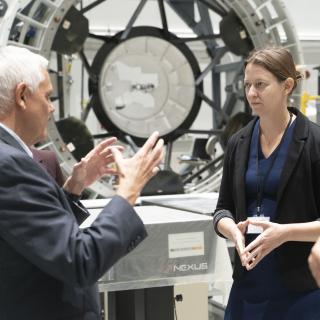
  • De izquierda a derecha, José Alonso Burgal, gestor; Valentín Martínez Pillet, director del Instituto de Astrofísica de Canarias (IAC); Alfonso Ynigo Rivera, ingeniero de sistemas; y Álex Oscoz, jefe del Departamento e investigador principal de IACTEC Espacio, durante su participación en el Space Symposium 2026.
    The Instituto de Astrofísica de Canarias is taking part in the 41st edition of the leading international space forum, held in Colorado Springs from 13 to 16 April, within the Spain Pavilion organised by ICEX alongside 16 other organisations from the sector. The Instituto de Astrofísica de Canarias (IAC), through IACTEC Space, its department dedicated to the development of technology for small satellites, took part this week in Space Symposium 2026, held in Colorado Springs, Colorado, USA, from 13 to 16 April. The event, organised by the Space Foundation and now in its 41st edition, is the
    Advertised on
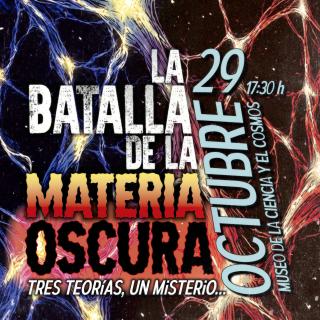
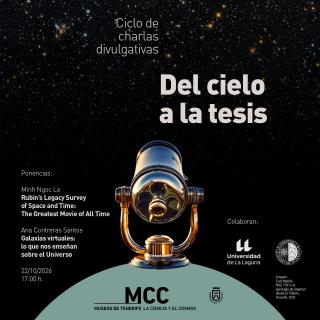
  • Cartel de la próxima sesión de Del Cielo a la tesis / IAC
    El Museo de la Ciencia y el Cosmos , del Organismo Autónomo de Museos y Centros del Cabildo de Tenerife, acogerá el próximo miércoles 23 de abril a las 17:00 horas una nueva entrega del ciclo de divulgación científica titulado “Del cielo a la tesis”, una iniciativa organizada por el alumnado del Instituto de Astrofísica de Canarias (IAC) y la Universidad de La Laguna (ULL). El ciclo, impulsado por estudiantado de doctorado del IAC, tiene como objetivo acercar a la ciudadanía los principales temas de investigación en Astrofísica narrados en primera persona por quienes los desarrollan. Las
    Advertised on
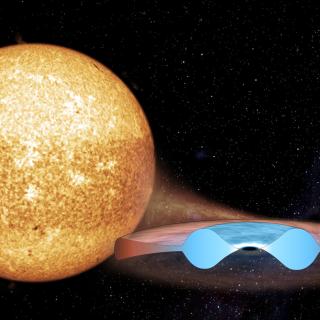
  • Necklace
    The Necklace nebula is a bipolar, post-common-envelope planetary nebula, the central star of which has been shown to have a dwarf carbon star companion. We aim to understand the origins of the Necklace and its dwarf carbon central star. We study the carbon abundance of the nebula through far-ultraviolet spectroscopy obtained with the Hubble Space Telescope. Furthermore, through simultaneous modelling of multi-band light and velocity curves, we attempt to constrain the parameters of the central star system. Puzzlingly, we find that the region of the inner nebula observed with the Hubble Space
    Advertised on
  • Two fans of blue and white dots extending up and down from center on a black background
    Last night, the 5,000 fibre-optic ‘eyes’ of the Dark Energy Spectroscopic Instrument (DESI) reached a major milestone, having fully covered the area originally planned for its map of the universe. Thus, DESI’s five-year programme has concluded ahead of schedule and with far more data than expected, resulting in the largest high-resolution 3D map of the universe ever produced. This map will enable researchers to explore dark energy, which accounts for 70% of the universe and drives its accelerated expansion. By comparing how galaxies were distributed in the past with their current
    Advertised on
  • Artist’s impression of the TOI-201 exoplanetary system
    An international team of scientists, including researchers from the Canary Islands Institute of Astrophysics (IAC), has confirmed the existence of three bodies orbiting the dynamic exoplanetary system TOI-201. They include a super-earth (TOI-201 d), a warm Jupiter (TOI-201 b) and a brown dwarf (TOI-201 c). The paper is published in Science Advances. “The goal was to characterize the TOI-201 planetary system to understand not just what planets are there, but how they interact with each other dynamically,” said Ismael Mireles, a PhD candidate in the UNM Department of Physics and Astronomy and
    Advertised on
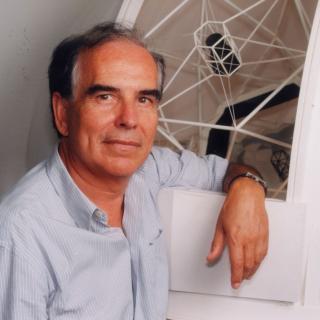
  • Rafael Rebolo López.
    The Instituto de Astrofísica de Canarias (IAC) celebrates the appointment of its researcher Rafael Rebolo López, Research Professor at the Spanish National Research Council (CSIC), as a Full Member of the Royal Academy of Exact, Physical and Natural Sciences of Spain (RAC), one of the country’s oldest and most prestigious scientific institutions. The election, unanimously agreed upon by the Academy’s plenary session in March, represents recognition of Rebolo’s extensive and distinguished scientific career, as well as his contribution to the development of modern astrophysics from Spain and
    Advertised on