
Bibcode
Cruz-Sanchez, N.; Fogantini, F. A.; Saavedra, E. A.; Abaroa, L.; García, F.; Combi, J. A.; Romero, G. E.
Bibliographical reference
Astronomy and Astrophysics
Advertised on:
1
2025
Journal
Citations
5
Refereed citations
5
Description
We report the results obtained from the analysis of XMM-Newton and NuSTAR observations of two ultraluminous X-ray sources (ULXs) located in the galaxies ESO 501–023 and IC 5052. To better understand their nature, we studied the spectral and timing behavior of these sources. We used spectral-timing techniques to investigate the presence of possible pulsations in the data. We did not detect any significant pulsations and set upper limits on the pulsed fraction of < 9% for ESO 501–023 ULX and < 11% for IC 5052 X-1. These sources exhibit typical ULX X-ray spectra and can be well fitted with two thermal components plus a Comptonization tail at high energies. To classify the sources, we compared their spectral parameters with those of other well-known ULXs. Our results show that ESO 501–023 ULX is in the broadened disk state and IC 5052 X-1 is in the hard ultraluminous state. Finally, our results suggest that the sources are likely nonmagnetic, supercritically accreting objects fed by companion stars.
Related projects
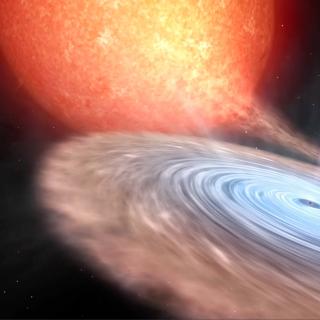
Black holes, neutron stars, white dwarfs and their local environment
Accreting black-holes and neutron stars in X-ray binaries provide an ideal laboratory for exploring the physics of compact objects, yielding not only confirmation of the existence of stellar mass black holes via dynamical mass measurements, but also the best opportunity for probing high-gravity environments and the physics of accretion; the most
Montserrat
Armas Padilla