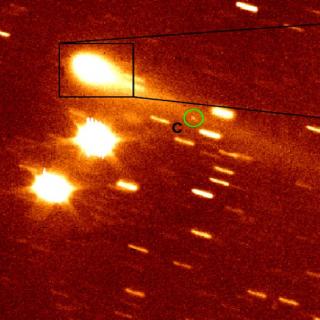
The International Astronomical Union (IAU) has approved the naming of asteroid (20747) Tanialepivert in honour of Tania Le Pivert Jolivet, a postdoctoral researcher at the Instituto de Astrofísica de Canarias (IAC), for her contributions to the study of primitive asteroids. The scientist thus joins the group of researchers affiliated with the IAC who have an asteroid named after them.
Tania Le Pivert Jolivet, a postdoctoral researcher at the Instituto de Astrofísica de Canarias (IAC), has been honoured with one of the most unique accolades a person dedicated to the study of the Solar System can receive: an asteroid will officially bear her name. The announcement was made during the international conference ‘Asteroids, Comets, Meteors’ (ACM 2026), held from 6 to 10 July in Poznań (Poland).
The asteroid, officially named (20747) Tanialepivert, was discovered on 8 January 2000 by the LINEAR (Lincoln Near-Earth Asteroid Research) project at the Lincoln Laboratory in Socorro, New Mexico (United States). The naming honours Le Pivert Jolivet’s scientific contributions to the study of the composition of primitive asteroids, a line of research that is fundamental to understanding the origin and evolution of the Solar System. With this designation, Tania Le Pivert Jolivet becomes the fifth researcher associated with the IAC to have her name immortalised on an asteroid.
The researcher carries out her work at the IAC, analysing the composition of these small bodies by studying spectra in the visible and infrared ranges obtained using both ground-based and space-based telescopes. Her research also includes the laboratory analysis of asteroid samples brought back to Earth by space missions.
“It is a great honour to receive this award at the ACM gala dinner. In an academic environment full of pressure and uncertainty, it is truly gratifying to be recognised by the scientific community. This is a source of motivation to continue my research,” says Tania Le Pivert Jolivet.
The approval of the name appears in the latest bulletin published by the Working Group for Small Body Nomenclature (WGSBN) of the International Astronomical Union (IAU), the body responsible for assigning official names to minor planets, comets and satellites of minor planets. In its bulletin dated 9 July 2026, the group approved the naming of 208 new minor planets, including (20747) Tanialepivert.
The granting of an official name to an asteroid constitutes international recognition of a person’s scientific contribution. Proposals are assessed and approved by the WGSBN, a committee of specialists within the IAU responsible for upholding rigorous and consistent criteria for the naming of minor bodies in the Solar System.
There are currently more than 26,000 minor planets with official names, a distinction reserved for individuals whose work has made a significant contribution to the advancement of scientific knowledge, space exploration or the popularisation of astronomy.
The naming of (20747) Tanialepivert follows on from other honours bestowed upon researchers affiliated with the IAC. Previously, this honour was bestowed upon Julia de León, with the asteroid (8324) Juliadeleón; Javier A. Licandro, with (17919) Licandro; Miquel Serra-Ricart, with (549151) Serra-Ricart; and Eri Tatsumi, with the asteroid (41002) Tatsumi.
This latest accolade highlights the IAC’s outstanding contribution to the study of small bodies in the Solar System and reinforces the international standing of its researchers in this field.
Contact at the IAC:
Tania Le Pivert Jolivet, tania.lepivert [at] iac.es (tania[dot]lepivert[at]iac[dot]es)