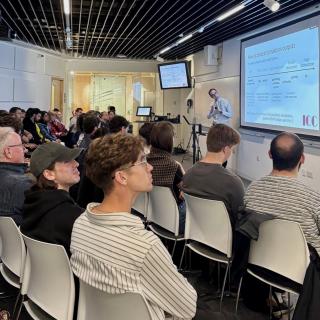
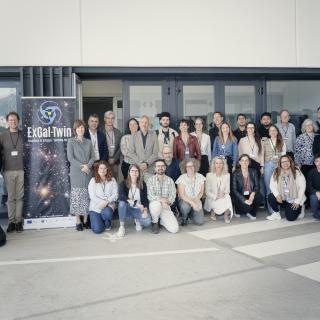
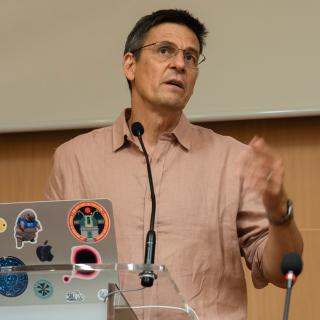
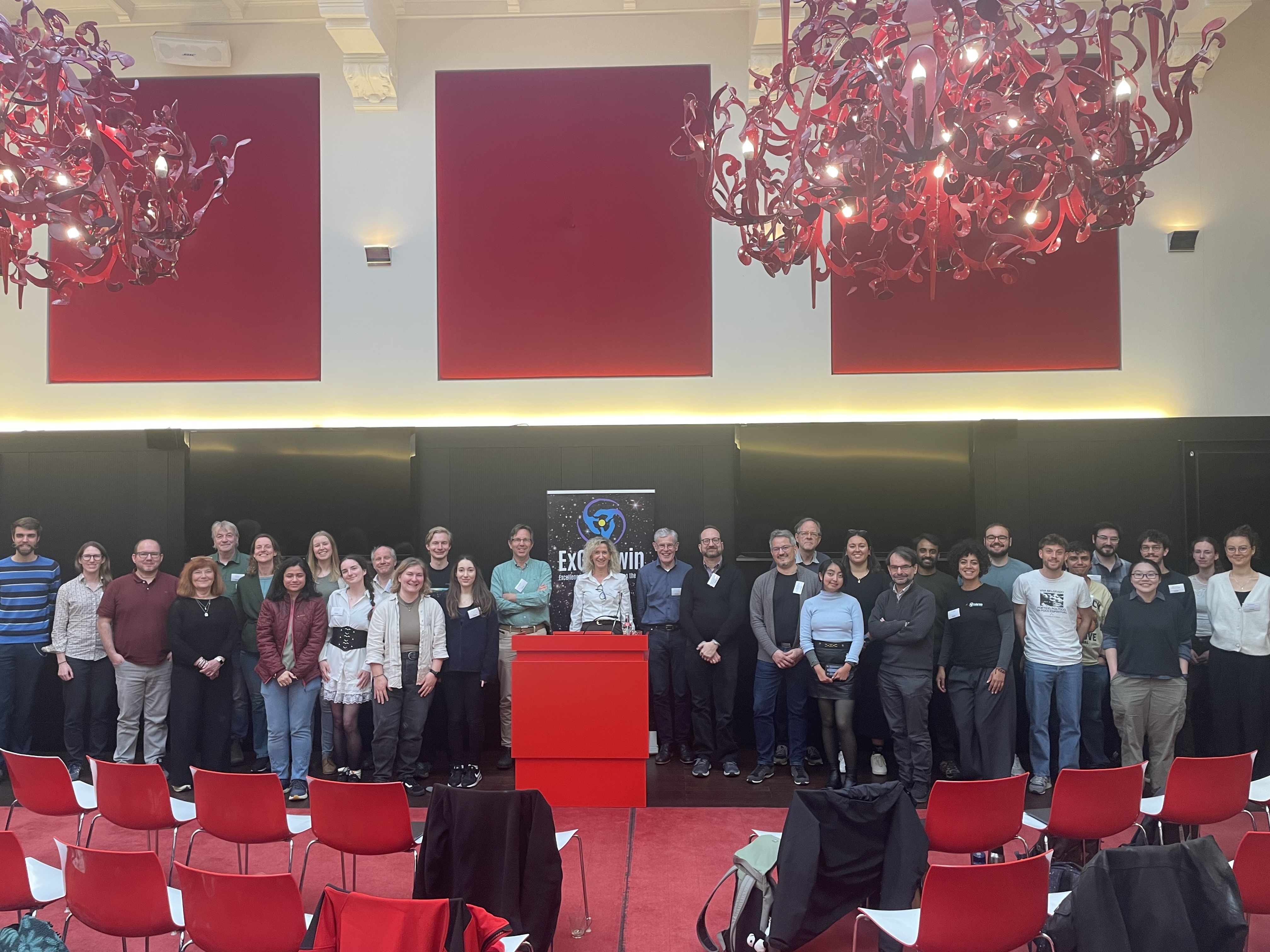
From 13 to 17 April 2026, the University of Groningen (The Netherlands) hosted the ExGal-Twin 2nd Radio Astronomy School and 2nd Project Meeting, key activities of the European project ExGal-Twin, coordinated by the Instituto de Astrofísica de Canarias (IAC).
The event brought together researchers, students and technical staff from the IAC and the partner institutions: the Kapteyn Astronomical Institute (University of Groningen), the Institute for Computational Cosmology (Durham University), and the Observatoire Astronomique de Strasbourg (CNRS), reinforcing scientific collaboration and capacity building within the consortium.
Training in radio astronomy
The Radio Astronomy School (13–14 April) gathered 31 participants, mainly early-career researchers. The programme combined theoretical lectures and practical sessions, covering:
Fundamentals of radio astronomy and interferometry
Calibration and imaging techniques
Data analysis tools and methodologies
The school aimed to provide participants with essential skills to work with radio astronomical data, supporting their professional development in this rapidly evolving field.
Scientific coordination and project progress
The 2nd Project Meeting (15–17 April) brought together 36 participants from across the consortium. The meeting focussed on:
Presenting scientific and technical progress
Strengthening collaboration among partners
Defining next steps and strategic priorities
These discussions are essential to achieving the objectives of ExGal-Twin, which seeks to enhance the research capacity and international competitiveness of the IAC in the field of galaxy evolution.
Strengthening collaboration and capacity building
By combining training and coordination activities, the event represents an important milestone in the project, promoting knowledge exchange, networking and long-term collaboration among participating institutions.
The ExGal-Twin project is funded by the European Union under the Widening Participation programme. Project: [101158446] — [ExGal-Twin] — [HORIZON-WIDERA-2023-ACCESS-02] Views and opinions expressed are however those of the author(s) only and do not necessarily reflect those of the European Union or the European Research Executive Agency. Neither the European Union nor the granting authority can be held responsible for them. |