Deep images of eight galaxies analogous to the Milky Way from the BEARD project, observed with the Wide Field Camera on the Isaac Newton telescope at the Roque de los Muchachos Observatory. From left to right, and from upper to lower: NGC3938, NGC2543, NGC1090, NGC1087, NGC3486, NGC7606, NGC3614 y NGC3810. © Javier Román y Carlos Marrero de la Rosa.
The international BEARD project, led from the Instituto de Astrofísica de Canarias (IAC) and the University of La Laguna (ULL), has used data from several telescopes at the Roque de los Muchachos Observatory, and computer simulations to explain how galaxies similar to the Milky Way have managed to survive the most violent stages of the history of the Universe.
The present model for the evolution of the universe predicts an epoch dominated by important mergers of galaxies some ten thousand million years ago. “It’s a case of violent interactions, in which it is foreseeable that weak structures such as the thin discs of spiral galaxies would be destroyed,” says Jairo Méndez Abreu, an astrophysicist at the IAC and the ULL, and Principal Investigator of the BEARD Project. “Galaxies, as well as discs usually have other thicker components which are the luminous spheroids found in the centres of spiral galaxies,” he continues.
However some galaxies are purely discs, and lack stabilising structures to help them survive during the hardest periods of their cosmic lives. This is the case for our home galaxy, the Milky Way. “How is it possible that our Galaxy and others which are similar, have lasted until now in spite of not having large bulges in their centres? This is one of the basic questions which BEARD sets out to answer by analysing galaxies similar to the Milky Way, not only real ones but also galaxies produced in computer simulations,” continues Adriana de Lorenzo-Cáceres Rodríguez, another astrophysicist at the IAC and ULL who is Co-Principal Investigator on BEARD.
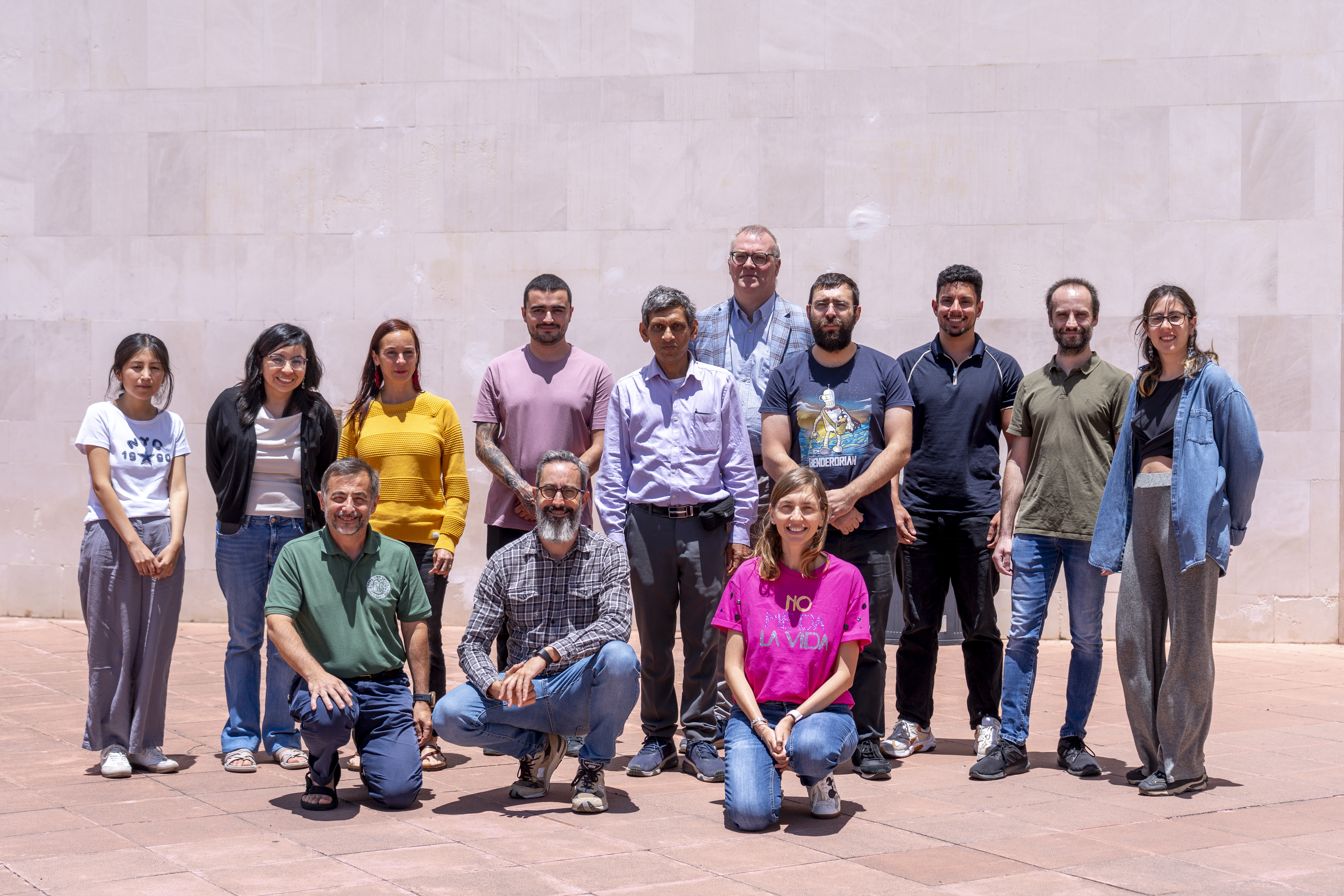
The BEARD project (initials of the English expression “Bulgeless Evolution and the Rise of Discs”) is an international project in which 35 researchers from 13 institutions in six countries (Spain, Italy, The Netherlands, the UK, Mexico and Chile) are participating. The International Scientific Committee of the Canary Island Observatories granted BEARD more than 600 hours of observing time on a range of telescopes at the Roque de los Muchachos Observatory (ORM) on the island of La Palma to study 54 “analogue” galaxies to the Milky Way. In addition the team includes experts in numerical simulations to study this kind of objects from a theoretical angle. The first results have been published in three scientific articles in the journal Astronomy & Astrophysics.
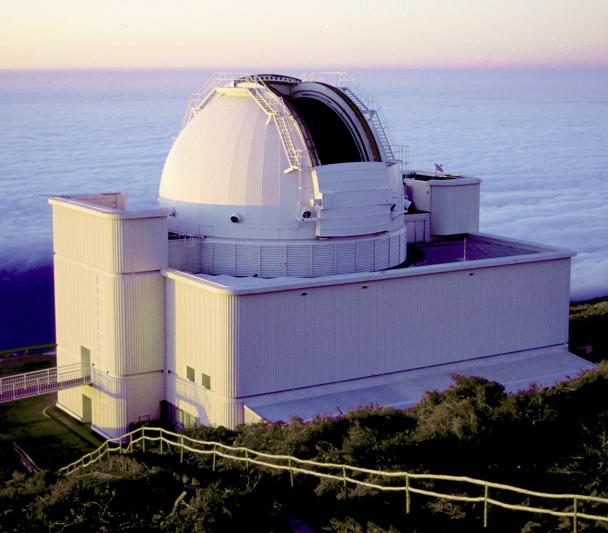
Carlos Marrero de la Rosa, a PhD student at the IAC, and first author of the first article, has analyzed deep images taken with the Isaac Newton telescope at the ORM. “We have applied a new technique to the analysis to reveal the faintest parts of the galaxies analogous to the Milky Way, defining its extent very precisely, and have found small but significant differences relative to the galaxies with bulges. Our conclusion is that these differences can be explained by specific configurations in the fusion processes for the galaxies with no bulges, an aspect which we have explored in detail in BEARD.”
“Using numerical simulations we have shown that galaxies without a bulge such as our Milky Way can survive during the epoch of the largest merger rate in the universe by two possible mechanisms. On the one hand there is a small possibility that some galaxies do not interact with others, in spite of the high frequency of these violent events. On the other hand we have discovered that there is a particular configuration of the interaction in which the simple discs are not destroyed” explains Yetli Rosas Guevara, a researcher at the University of Cordoba (UCO), first author of the second of the recently published scientific articles. “In this second mode, the galaxies need to merge after a rhythmic dance, rotating in the same sense, and approaching each other in the same plane, like a couple rotating around one another on the same dance floor” continues the researcher.
"Galaxies are usually accompanied by a system of smaller satellite galaxies, remains of past merger processes,” claims Salvador Cardona-Barrero, a researcher at the IAC and ULL, and first author of the third scientific article from BEARD. “Galaxies analogous to the Milky Way have a distribution of satellites different from the other galaxies, more concentrated and aligned, as expected from a more tranquil and ordered merger history. This result is in agreement with the explanations given by BEARD for the cosmic survival of the disc of the Milky Way."
So BEARD has managed to explain the existence of galaxies like the Milky Way within the currently accepted model of the universe, and is continuing to study other aspects of the lives of these objects. For this purpose the team has produced the largest (and only) catalogue of galaxies analogous to the Milky Way available until now. All the observed data and products of the analysis are being made available to the international scientific community in a public archive on the website of the project, where educational material can also be found. In this context we note the preparation of five comics “The battle of the galaxies” produced in collaboration with the astrophysicist, teacher and artist Luis G. Leiva, and aimed at helping secondary school students to become familiar with present-day knowledge about spiral galaxies in general and our Milky Way in particular.
| The BEARD project has been partially funded by the State Research Agency of the Ministry of Science and Education via the Project for Knowledge Generation CoBEARD (PID2021-128131NB-I00), as well as by the European Fund for Regional Development (FEDEER) “A way to build Europe”. |
Contacto en el IAC y la ULL:
Adriana de Lorenzo-Cáceres Rodríguez (adlcr [at] iac.es (adlcr[at]iac[dot]es) / alorenzc [at] ull.edu.es (alorenzc[at]ull[dot]edu[dot]es))
Jairo Méndez-Abreu (jma [at] iac.es (jma[at]iac[dot]es) / jmendeza [at] ull.edu.es (jmendeza[at]ull[dot]edu[dot]es))