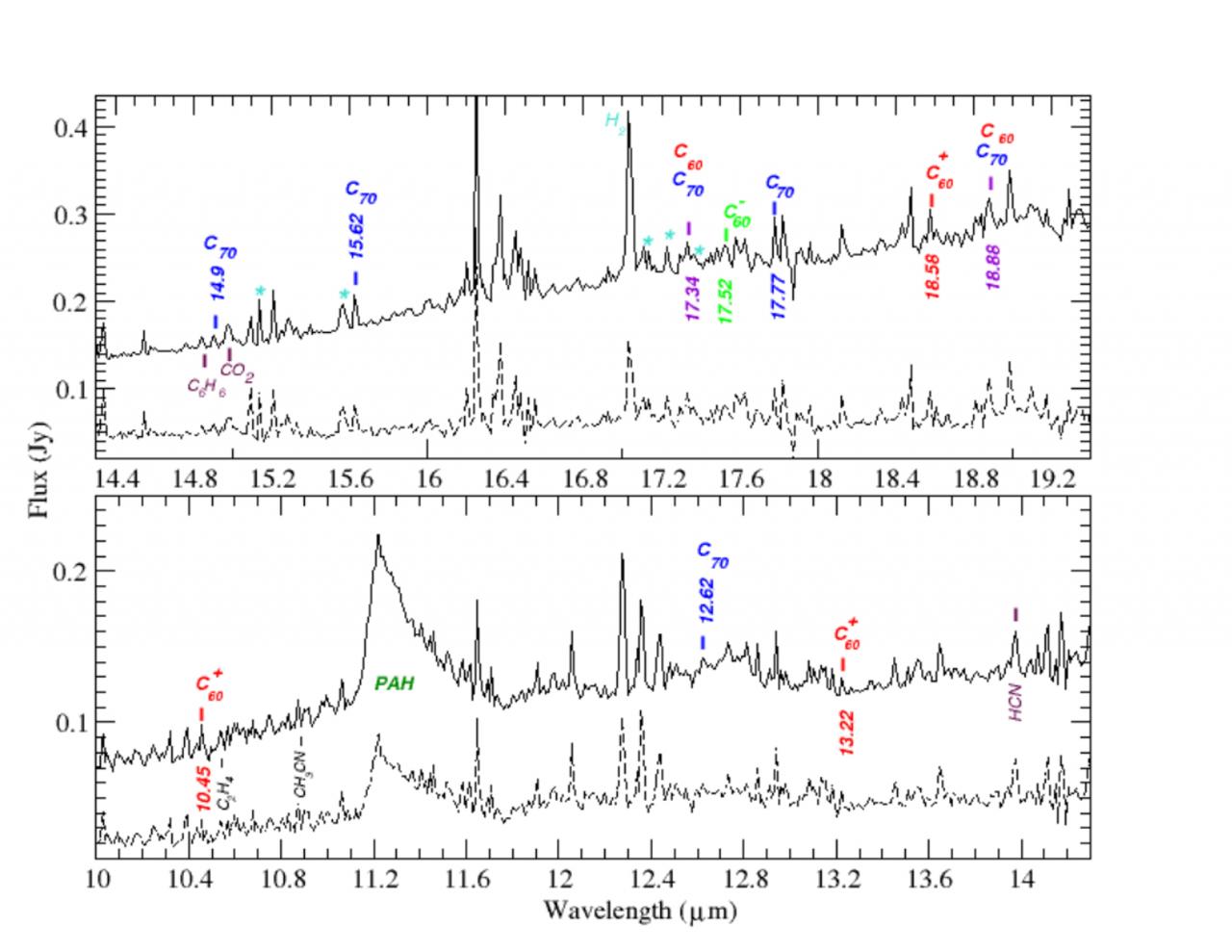
We present the detection of fullerenes C60 and C70 in the star-forming region IC 348 of the Perseus molecular cloud. Mid-IR vibrational transitions of C60 and C70 in emission are found in Spitzer IRS spectra of individual stars (LRLL 1, 2, 58), in the averaged spectrum of three other cluster stars (LRLL 21, 31, and 67) and in spectra obtained at four interstellar locations distributed across the IC 348 region. Fullerene bands appear widely distributed in this region with higher strength in the lines of sight of stars at the core of the cluster. Emission features consistent with the three most intense bands of the C60+ and with one of C60- are also found in several spectra, and if ascribed to these ionized species it would imply ionization fractions at 20 and 10 per cent, respectively. The stars under consideration host protoplanetary discs, however the spatial resolution of the spectra is not sufficient to disentangle the presence of fullerenes in them. If fullerene abundances in the cloud were representative of IC 348 protoplanetary discs, C60, the more abundant of the two species, could host 0.1 per cent of the total available carbon in the discs. This should encourage dedicated searches in young discs with upcoming facilities such as the JWST. Fullerenes provide a reservoir of pentagonal and hexagonal carbon rings which could be important as building blocks of prebiotic molecules. Accretion of these robust molecules in early phases of planet formation may contribute to the formation of complex organic molecules in young planets.
Averaged Spitzer spectra in the MIR of LRLL 21, 31 and 67, solid line and 4 interstellar locations (broken line) in IC348. The location of Fullerenes, organic molecules and water are indicated.
It may interest you
-
An international collaboration of astronomers led by the Universidad de La Laguna (ULL) and Instituto de Astrofísica de Canarias (IAC) has identified two intriguing, humongous but light planets orbit ing HD 114082. This star is only 15 million years old, this is, much younger than the Sun (4.6 billion years old) , spin s 15 times faster , has 28% more mass , and is about one thousand degrees hotter and almost four times more luminous. Its planets receive about 200 times more light and heat than Jupiter. The study, which involved separating the faint planetary signal from the stellar oneAdvertised on -
Research on the formation, origin, and evolution of the dichotomy between the thin and thick disk components of the Milky Way has been a major topic of study, as it is key to understanding how our Galaxy formed. However, this is not an easy task, since populations defined by their morphology or kinematics show a mixture of chemically distinct stellar populations. Age therefore becomes a fundamental parameter for understanding the evolution of the Galactic disk. Our goal is to derive the age and metallicity distributions of the thin and thick disks defined kinematically, in order to revealAdvertised on -
El Cabildo y el IAC fabricarán la primera constelación de satélites canaria para observar y proteger el Archipiélago desde el espacioAdvertised on