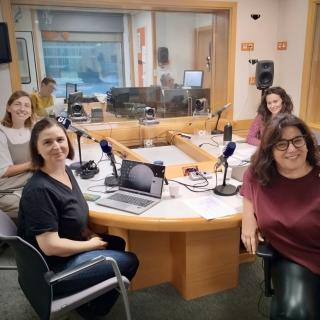

The course, taught by Hannah Thiel, a researcher at the Vigo Quantum Communication Center, brought Institute staff together around the foundations, applications and technological challenges of quantum communications and quantum key distribution.
The Instituto de Astrofísica de Canarias (IAC) held a specialised course on quantum communications on 28 and 29 July, organised at the invitation of the Free Space Optics Communications Lab of the CELESTE project. The training, delivered by researcher Hannah Thiel, from the Vigo Quantum Communication Center at the Universidad de Vigo, took place at the IAC headquarters in La Laguna.
The initiative forms part of the training and technological strengthening activities promoted by CELESTE, a project aimed at consolidating new scientific and instrumental capabilities in strategic areas for astrophysics, space technologies and applied innovation from the Canary Islands. In this context, the Free Space Optics Communications Lab, whose Principal Investigator is Luis Fernando Rodríguez Ramos, works on the development of advanced laser-based systems to transmit data at very high speed between Earth and space, combining free-space optical communications, quantum key distribution, adaptive optics, integrated photonics and advanced detection technologies.
Over two days, the course offered a structured introduction to the principles of quantum information and its application to secure communications. The programme addressed topics such as the motivation behind quantum communications, the concept of the quantum bit, basic mathematical notation, the no-cloning theorem, security in quantum communications and ways of encoding quantum information.
The training also explored quantum key distribution (Quantum Key Distribution, QKD), one of the key technologies for developing secure communications against future computational threats. Topics covered included the BB84 protocol, key distillation processes, the main types of attacks, the identification of issues in real systems, and different implementations based on temporal degrees of freedom, polarisation and quantum entanglement.
The speaker, Hannah Thiel, is a researcher at the Vigo Quantum Communication Center and is part of the Antennas, Radar and Optical Communications Group. Her career has focused on quantum optics and photonics, with experience in the design, fabrication and characterisation of miniaturised quantum communication devices. During her predoctoral stage, she took part in the European project Horizon 2020 UNIQORN, dedicated, among other objectives, to the on-chip generation and analysis of time-bin entangled photon pairs. In 2023, she joined the VQCC as a postdoctoral researcher to work on satellite-based quantum communication.
The course enabled IAC staff to deepen their understanding of fundamental concepts for the development of future optical and quantum communication infrastructures. These technologies are especially relevant to the Free Space Optics Communications Lab, which explores fast, secure and resilient communication systems from the Canary Islands for ground, airborne and space platforms. Its research connects fundamental science with real-world applications and contributes to the development of next-generation communication technologies.
One of the laboratory’s main objectives is IAClink, a European testbed for optical communications that will connect the Observatorio del Teide, in Tenerife, with the Telescopio Jacob Kapteyn at the Observatorio del Roque de los Muchachos, in La Palma, over a distance of 144 kilometres. This real optical link between islands will make it possible to validate optical and quantum communication terminals, test QKD systems under realistic atmospheric conditions, optimise control and pointing algorithms, and assess the performance of adaptive-optics correction over long-distance links.
The course reinforces the IAC and CELESTE’s commitment to promoting specialised knowledge in emerging areas with high scientific and technological impact. Quantum communications, integrated photonics, adaptive optics and Earth-space optical links are strategic fields for the future of secure, high-speed communications, as well as for the development of new experimental capabilities from the Canary Islands observatories.
With initiatives such as this, the IAC continues to strengthen the preparation of its teams in key technologies for the next generation of scientific and space infrastructures. Within the framework of CELESTE, the Free Space Optics Communications Lab helps to position the Canary Islands as a reference node for the development, validation and transfer of advanced solutions in optical and quantum communications.