
False-color view of the giant galaxy M87 combining visible-light observations (Credits: SDSS, MegaCam/CFHT, MEGARA/GTC). The diffuse white light traces billions of old stars, while the red structures reveal the network of filaments extending largely to the left of the galaxy’s center. The two zoomed regions correspond to areas observed in detail with MEGARA/GTC, showing the inner (right) and outer (left) filaments of particular interest within this complex system.
An international team of astronomers has captured the most detailed and completed view yet of the mysterious filaments surrounding the giant galaxy M87. Using new observations from the Gran Telescopio Canarias and the Canada-France-Hawaii Telescope, the study reveals how these long, thread-like structures move, evolve, and interact with their galactic environment and the activity of the central supermassive black hole. These findings have just been published in Monthly Notices of the Royal Astronomical Society.
M87: a giant galaxy and its mysterious threads
M87, located about 55 million light-years away, is a supergiant elliptical galaxy best known for its extremely active supermassive black hole at its core. This 6.5-billion-solar-mass engine – made famous in recent years by the Event Horizon Telescope collaboration, which imaged its shadow for the first time – is responsible for launching jets of high-energy particles far beyond the galaxy, a spectacle best seen in radio light. Depending on how much material the black hole is feeding on, its jets go through highly active periods followed by quieter ones. Even so, they play a major role in shaping both the galaxy itself and the hot gas that surrounds it.
M87 sits in a very special environment: the earth of the Virgo galaxy cluster, a gigantic system containing thousands of galaxies and immersed in a hot, diffuse intracluster gas reaching tens of millions of degrees. Like many central galaxies, M87 is threaded by a complex network of long, thin filaments stretching far from its center. Despite decades of study, their origin is still uncertain. Where do they come from? How can such thin structures survive in such a harsh environment? And how closely are they linked to the black hole’s activity, as many astronomers believe they are?
“M87 is the closest galaxy known to host such filamentary structures,” explains Camille Poitras, lead author of the study and master’s student at Université Laval (Québec, Canada). “It’s probably one of very few to display filaments so far from the center that it looks detached, ‘floating’ beyond the galaxy.”
A detailed portrait of the filaments
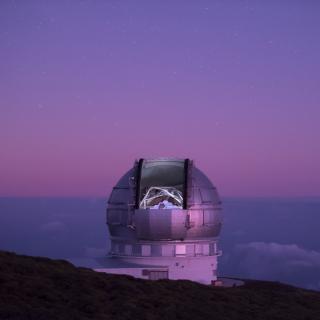
To better understand these filaments, the international team of astronomers combined two complementary sets of observations. First, they used the MEGARA instrument on the Gran Telescopio Canarias (GTC) to study two unique regions: complex filaments near the center, close to the current jets, and another much farther out, almost beyond the galaxy in a calmer environment. To complete this picture, the team also used new observations from the Canada-France-Hawaii Telescope (CFHT) using SITELLE instrument, which provided a panoramic view of the full filament network. Together, these datasets offer the most comprehensive view to date of M87’s filaments, revealing their motions, composition, and connections to the surrounding environment.
Astronomers have long known that M87’s filaments are far from calm. Previous studies showed that those near the center are highly turbulent and chaotic, disturbed by the powerful jets launched by the black hole. Thanks to the high resolution of MEGARA, the team found that these filaments are also stirred by smaller, local motions –probably caused by explosions of old stars known as type Ia supernovae, which are common throughout the galaxy. "MEGARA's ability to provide spatial information about these filaments, combined with the sensitivity afforded by a telescope such as the GTC, has been fundamental in enabling us to study these subtle structures in detail,’ says Antonio Cabrera Lavers, head of scientific operations at the GTC.
Farther out, the picture changes completely. The detached outer filament moves in a steadier and more uniform way, and its presence appears to be linked to an earlier jet from a past period of activity. The composition of the gas within these filaments also varies. Closer to the center, it’s more affected by the black hole and its active jets, and shows different chemical signs than the gas farther away. However, even the distant filament displays an unexpected composition for such a calm area, suggesting that there may be underlying processes at work that are not yet fully understood.
“These new observations helped us pinpoint how the black hole’s outflows from M87’s shape and energize these filaments,” explains Marie-Lou Gendron-Marsolais, assistant professor at Université Laval and co-author of the study. “They are ‘living’ evidence of how the black hole affects the galaxy, even far from its heart.”
These results show that the filaments are closely connected to both the present and past activity of M87’s supermassive black hole. A mix of different processes – such as jets, stellar explosions, and the interaction between hot and cold gas – appear to work together to shape and move these thin structures. Understanding how these processes combine is still a challenge, but future high-resolution observations and innovative analysis techniques will be key to revealing how they form, survive, and evolve over time.