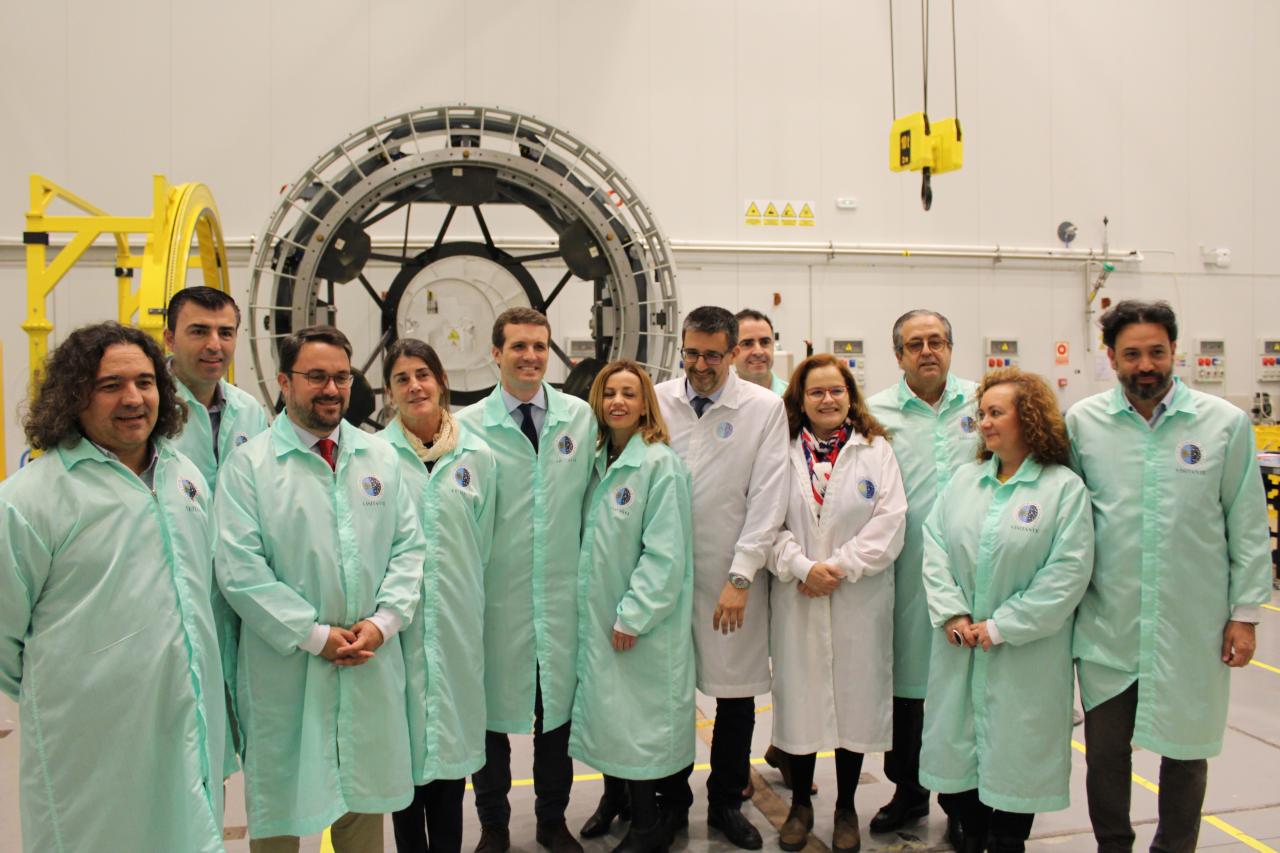
Esta mañana, Pablo Casado, presidente del Partido Popular (PP) y candidato a la Presidencia del Gobierno de España, visitó la sede central del Instituto de Astrofísica de Canarias (IAC), en La Laguna, junto con otros representantes de su partido. El político se mostró interesado en conocer la labor investigadora y de desarrollo tecnológico que se realiza en el IAC y en los Observatorios de Canarias, así como los proyectos de futuros telescopios. Acompañado por Casiana Muñoz-Tuñón, subdirectora del IAC, y otros miembros del Comité de Dirección de este centro, Casado recorrió las instalaciones y accedió a los talleres y laboratorios donde se diseñan, fabrican y montan los instrumentos que después se envían tanto a telescopios terrestres como al espacio.
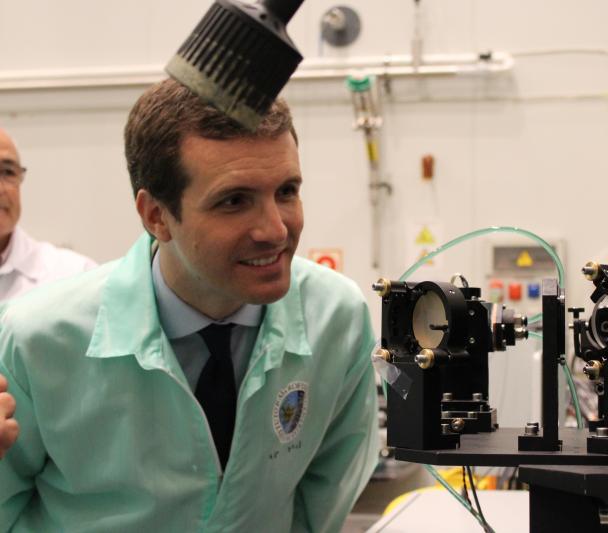
Pablo Casado junto a representantes de su partido y miembros del Comité de Dirección del Instituto de Astrofísica de Canarias. Crédito: Jorge Dóniz (IAC).
Advertised on
It may interest you
-
The Instituto de Astrofísica de Canarias (IAC) welcomed the visit of Professor Didier Queloz, Nobel Laureate in Physics and co-discoverer of the first exoplanet orbiting a Sun-like star. Professor Queloz's stay at the IAC has focused on instrumental development and technological collaboration. As part of his agenda, he also gave a lecture entitled ‘Exoplanets: the next frontier’ in the IAC Lecture Hall. The researcher visited the IAC to supervise the installation of a new high-stability spectrograph on the Isaac Newton Telescope (INT) at the Roque de los Muchachos Observatory on La PalmaAdvertised on -
Cristina Ramos Almeida, investigadora del Instituto Astrofísico de Canarias (IAC) y coautora de más de un centenar de artículos sobre galaxias y agujeros negros, ha sido una de las homenajeadas en la primera edición de los premios "Mujeres tenían que SER" de Radio Club Tenerife, Cadena SER. El evento, celebrado en la noche del miércoles 29 de octubre, en la sala Adán Martín del edificio de Presidencia del Gobierno en Santa Cruz de Tenerife, ha teñido el espacio de reconocimiento al talento femenino en diversos ámbitos. La distinción resalta la crucial contribución de Ramos Almeida a laAdvertised on -
A team of cosmologists from the Institute of Astrophysics of Andalusia (IAA-CSIC) and the Institute of Astrophysics of the Canary Islands (IAC) has obtained the most accurate census to date of the dark matter halos of the Universe. The work is based on the development of a new model, called GPS+, capable of predicting how many dark matter halos exist at each stage of cosmic history. In the universe, there are enormous invisible structures surrounding galaxies and galaxy clusters. These are dark matter halos, concentrations of matter that do not emit light and cannot be directly observed, butAdvertised on