News

This section includes scientific and technological news from the IAC and its Observatories, as well as press releases on scientific and technological results, astronomical events, educational projects, outreach activities and institutional events.

Displaying 1951 - 1956 of 2884
Advertised on
  • Ciclo de divulgación “Del Cielo a la Tesis”
    El ciclo de divulgación “Del Cielo a la Tesis” regresa este mes de febrero para acercar el trabajo de los jóvenes investigadores del Instituto de Astrofísica de Canarias (IAC) al público. En esta ocasión, la sesión se celebrará el próximo jueves 19 de febrero, en el Museo de la Ciencia y el Cosmos (MCC) del Organismo Autónomo de Museos y Centros del Cabildo de Tenerife. Eso sí, esta vez cambiará de horario y la sesión dará comienzo a las 17:00h. La jornada contará con dos ponencias centradas en la Astrofísica de altas energías y la búsqueda de respuestas sobre los componentes invisibles del
    Advertised on
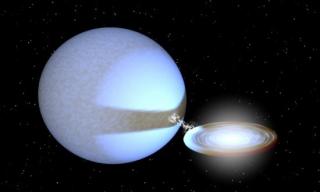
  • Artistic view of the system Swift J1357.2-0933. The vertical structure present in the inner accretion disc produces the optical dips with a periodicity of a few minutes whereas the orbital period is 2.8h. G. Pérez (SMM/IAC).
    Stellar-mass black holes (BHs) are mostly found in X-ray transients, a subclass of X-ray binaries that exhibit violent outbursts. None of the ~50 galactic BHs known show eclipses, which is surprising for a random distribution of inclinations. Swift J1357.2−093313 is a very faint X-ray transient detected in 2011 by the Swift telescope. Our spectroscopic evidences show that it contains a BH in a 2.8h orbital period. High-time resolution optical light curves display profound dips of up to 0.8 mag (50% of the optical flux) in 2min without X-ray counterparts. The observed properties are best
    Advertised on
  • Redshift evolution of the ratio of the relic galaxies to the total number of massive galaxies. The three different lines represent the three considered models. Coloured areas, orange (orange-red) show galaxies that have increased their masses less than a
    The number of present-day massive galaxies that has survived untouched since their formation at high-z is an important observational constraint to the hierarchical galaxy formation models. Using three different semianalytical models based on the Millenium simulation, we quantify the expected fraction and number densities of the massive galaxies form at z>2 which have evolved in stellar mass less than 10% and 30%. We find that only a small fraction of the massive galaxies already form at z~2 have remained almost unaltered since their formation (<2% with Delta_M*/M*<0.1 and <8% with Delta_M*/M
    Advertised on
  • Upper panel: composite image of NGC 6946 obtained by adding all the wavelengths for the Hα scan. The circle indicates the position of region at RA: 308.6998566 degrees, DEC: +60.1772541 degrees. Lower panel: spectral energy distribution for Hα + [NII] (le
    Using the OSIRIS tunable narrow band imager on the 10.4m GTC (La Palma) we have mapped the SAB(rs)cd galaxy NGC 6946 over a 7.3x7.5 square arcminutes field in the emission lines of the [SII]\lambda\lambda, 6717, 6731 doublet, and in H\alpha. From these maps we have produced catalogs of the H\alpha luminosities and effective radii of 557 HII regions across the disk, and derived the [SII] emission line ratios of 370 of these. The H\alpha observations were used to derive the mean luminosity-weighted electron densities for the regions of the sample, while the [SII] line ratios allowed us to
    Advertised on