
Bibcode
Rahna, P. T.; Akhlaghi, M.; Fernãndez-Ontiveros, J. A.; Zheng, Z.-Y.; Hernán-Caballero, A.; Amorín, R.; López-Sanjuan, C.; Diego, J. M.; Díaz-García, L. A.; Vílchez, J. M.; Lumbreras-Calle, A.; Fernández Gil, D.; Gurung-López, S.; Jiménez-Teja, Y.; Ederoclite, A.; González Delgado, R. M.; Vázquez Ramió, H.; Abramo, R.; Alcaniz, J.; Benítez, N.; Bonoli, S.; Carneiro, S.; Cenarro, J.; Cristóbal-Hornillos, D.; Dupke, R.; Hernández-Monteagudo, C.; Marín-Franch, A.; Mendes de Oliveira, C.; Moles, M.; Sodré, L., Jr.; Taylor, K.; Varela, J.
Bibliographical reference
Astronomy and Astrophysics
Advertised on:
11
2025
Journal
Citations
1
Refereed citations
1
Description
We report the discovery of a massive Lyα nebula (potentially largest ever discovered), RaJav, at z = 2.25, associated with a quasar pair: the bright SDSS J162029.07+433451.1 (hereafter J1620+4334) and the faint newly discovered quasar JPAS-9600-10844, at 2.265 ± 0.021 using the early data release (17 deg2) of the Javalambre Physics of the Accelerating Universe Astrophysical Survey (J-PAS). The quasar JPAS-9600-10844 embedded in the nebula is located at ∼60.2 kpc (7.3″) from J1620+4334, and shows a compact structure with broad emission lines (> 3000 km/s), typical of active galactic nuclei (i.e., Lyαλ1216 and CIV λ1548). At a 2σ surface brightness (SB) contour of ∼1.86 × 10⁻¹⁶ erg s−1 cm−2 arcsec−2, the nebula extends beyond 100 kpc and has a total Lyα luminosity of ∼5.8 ± 0.7 × 1044 erg s−1 which signifies the presence of an enormous Lyα nebula (ELAN). The nebula traces an overdensity of quasars at a redshift of 2.2─2.3 consistent with the progenitor of a massive galaxy cluster. The extended CIV emission with luminosity of ∼3.7 ± 0.5 × 1044 erg s−1 indicates that the circumgalactic medium (CGM) is metal-enriched and not primordial. The current J-PAS observations suggest photoionization and shocks due to outflows as possible ionization mechanisms. The faint extended far-UV and near-UV continuum emission likely points to ongoing star formation around the two quasars, suggesting a complex interaction in their environments. These findings provide new insights into the environment of quasars and their role in shaping the dynamics and evolution of the CGM at cosmic noon. Further spectroscopic observations will be required to fully characterize the object's nature and its kinematic properties. This study demonstrates the unique capability of J-PAS to detect massive and rare Lyα nebulae, providing new insights into their properties, environments, and connections to large-scale structures in the cosmic web such as filaments and overdensities in a large cosmological volume.
Related projects
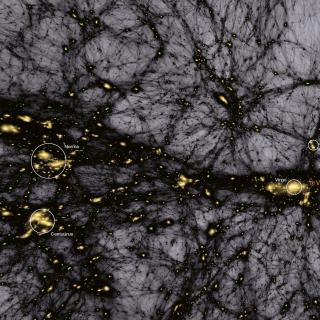
Cosmology with Large Scale Structure Probes
The Cosmic Microwave Background (CMB) contains the statistical information about the early seeds of the structure formation in our Universe. Its natural counterpart in the local universe is the distribution of galaxies that arises as a result of gravitational growth of those primordial and small density fluctuations. The characterization of the
Francisco Shu
Kitaura Joyanes