
Bibcode
Kravtsov, Vadim; Veledina, Alexandra; Berdyugin, Andrei V.; Poutanen, Juri; Tsygankov, Sergey S.; Shahbaz, Tariq; Torres, Manuel A. P.; Jermak, Helen E.; McCall, Callum; Steele, Iain A.; Kajava, Jari J. E.; Piirola, Vilppu; Sakanoi, Takeshi; Kagitani, Masato; Berdyugina, Svetlana V.
Bibliographical reference
Astronomy and Astrophysics
Advertised on:
11
2025
Journal
Citations
2
Refereed citations
2
Description
We present simultaneous high-precision optical polarimetric and near-infrared (NIR) to ultraviolet (UV) photometric observations of the low-mass black hole X-ray binary A0620−00 in a quiescent state. Subtracting interstellar polarization, estimated from a sample of field stars, we derived the intrinsic polarization of A0620−00. We show that the intrinsic polarization degree (PD) varies with the orbital period with an amplitude of ∼0.3%, at least in the R band, where the signal-to-noise ratio of our observations is the best. This implies that some fraction of the optical polarization is produced by a scattering of stellar radiation off the matter that follows the black hole in its orbital motion. In addition, we see a rotation of the orbit-average intrinsic polarization angle (PA) with the wavelength from 163° in the R to 177° in the B band. All of the above, combined with the historical NIR-to-optical polarimetric observations, demonstrates the complex behavior of the average intrinsic polarization of A0620−00: the PA continuously rotates from the infrared to the blue band by ∼53° in total, while the PD of ∼1% remains nearly constant over the entire spectral range. The spectral dependence of the PA can be described by Faraday rotation with a rotation measure of −0.2 rad μm−2, implying a magnetic field of a few gauss in the plasma surrounding the black hole accretion disk. However, our preferred interpretation of the peculiar wavelength dependence is an interplay between two polarized components with different PAs. Polarimetric measurements in the UV range can help in distinguishing between these scenarios.
Related projects
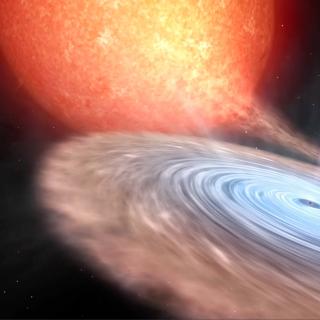
Black holes, neutron stars, white dwarfs and their local environment
Accreting black-holes and neutron stars in X-ray binaries provide an ideal laboratory for exploring the physics of compact objects, yielding not only confirmation of the existence of stellar mass black holes via dynamical mass measurements, but also the best opportunity for probing high-gravity environments and the physics of accretion; the most
Montserrat
Armas Padilla