Bibcode
Licandro, Javier; Pinilla-Alonso, Noemí; Holler, Bryan J.; De Prá, Mário N.; Melita, Mario; de Souza Feliciano, Ana Carolina; Brunetto, Rosario; Guilbert-Lepoutre, Aurélie; Hénault, Elsa; Lorenzi, Vania; Stansberry, John A.; Schambeau, Charles A.; Harvison, Brittany; Pendleton, Yvonne J.; Cruikshank, Dale P.; Müller, Thomas; McClure, Lucas; Emery, Joshua P.; Peixinho, Nuno; Bannister, Michele T.; Wong, Ian
Bibliographical reference
Nature Astronomy
Advertised on:
2
2025
Citations
33
Refereed citations
29
Description
Centaurs are small bodies orbiting between Jupiter and Neptune and behave as an intermediate population between trans-Neptunian-belt objects and Jupiter-family comets. As such, their surface composition and evolutionary processes are key to understanding the Solar System's history. However, the mechanisms driving their transformation and the impact of thermal processing on their surfaces remain open questions. Here we examined the surface properties of five Centaurs using the James Webb Space Telescope near-infrared spectrograph reflectance spectra (0.6-5.3 μm). They exhibit considerable diversity in surface composition. Our analysis indicates that Centaurs can be split into two main categories, which is also observed for trans-Neptunian objects: one group has surfaces composed of refractory materials with some water ice, whereas the other is dominated by carbon-based materials. Additionally, two of the five objects have primarily refractory surfaces with minimal volatiles, suggesting a high concentration of primitive, comet-like dust. We suggest that the observed Centaur surfaces reflect their transitional states, as they are shifting from being ice-rich bodies to progressively becoming more dominated by non-volatile materials as they approach the Sun. Such thermal processing may have changed the surface properties of other similar Solar System bodies, like comets, Jupiter trojans and D-type asteroids.
Related projects
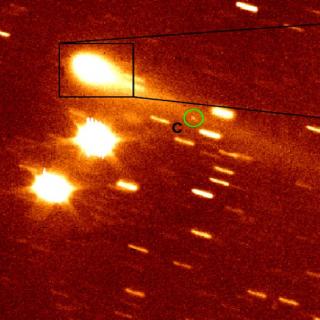
Small Bodies of the Solar System
This project studies the physical and compositional properties of the so-called minor bodies of the Solar System, that includes asteroids, icy objects, and comets. Of special interest are the trans-neptunian objects (TNOs), including those considered the most distant objects detected so far (Extreme-TNOs or ETNOs); the comets and the comet-asteroid
Julia de
León Cruz