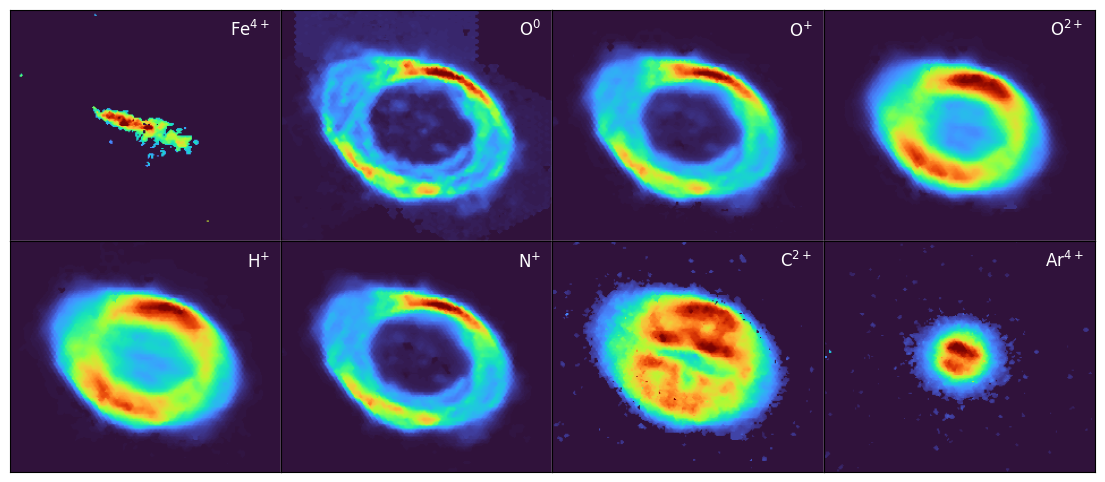
An illustrative set of 8 individual WEAVE LIFU emission-line images of the Ring Nebula. The colour in each panel tracks the brightness of emission, with brown-red being the most intense, shading through yellow and green to blue for the faintest emission. North is up and east, left. Full description
An illustrative set of 8 individual WEAVE LIFU emission-line images of the Ring Nebula. The colour in each panel tracks the brightness of emission, with brown-red being the most intense, shading through yellow and green to blue for the faintest emission. North is up and east, left.
The 4 emission line images that are combined in Figure 1 are shown separately in the top row. Left to right, the emission lines are: the [Fe V] 4227 Angstrom (422.7 nm) line due to four-times-ionized iron atoms; the [O I] 6300 Angstrom auroral line due to neutral oxygen atoms; the [O II] 3727 Angstrom line pair due to singly-ionized oxygen atoms; the [O III] 4959 Angstrom line due to twice-ionized oxygen atoms.
Bottom row, from left to right: emission in the 4861-Angstrom line that is produced as ionized hydrogen atoms recombine in the nebula; emission in the [N II] 6548 Angstrom line of singly-ionized nitrogen; emission in the C II 4267 Angstrom line resulting from the recombination of twice-ionized carbon atoms; emission in the [Ar V] 6435 Angstrom line by four-times-ionized argon.
Notice the very different appearance of the emission from four times ionized iron atoms (top left) compared to the emission from four-times-ionized argon atoms (bottom right) – usually, these ions of argon and iron arise in the same volume, as they require the same physical conditions.
The angular dimensions of each of the 8 frames are 120 x 110 arcseconds on the sky (E-W x N-S), corresponding to physical dimensions of 95,000 x 87,000 Astronomical Units (AU) at the 787 parsec distance of the Ring Nebula. An Astronomical Unit is the mean distance from the Sun to the Earth.