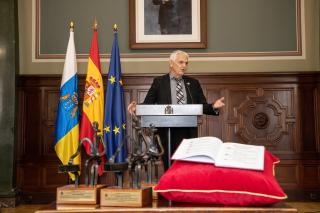
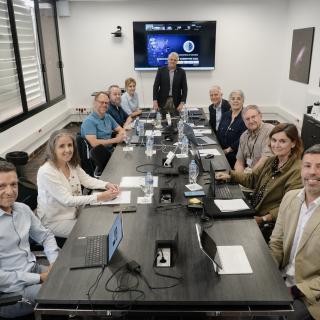
The exhibition, opened at the Museo de las Ciencias de Castilla-La Mancha, brings the search for Earth-like planets closer to the public and displays technological components developed by Spanish centres involved in the mission.
The Instituto de Astrofísica de Canarias (IAC) is participating in the temporary exhibition ‘In search of new Earths’, a display dedicated to the European space mission PLATO and to one of the major challenges in astrophysics today: the search for and characterisation of habitable Earth-like planets beyond the Solar System.
The exhibition, which can be visited until 30 August at the Museo de las Ciencias de Castilla-La Mancha, in Cuenca, has been developed by the Instituto de Astrofísica de Andalucía (IAA-CSIC), with the participation of the Fundación Española para la Ciencia y la Tecnología (FECYT) and the entire PLATO Spain consortium, which includes the Instituto de Astrofísica de Canarias (IAC), the Centro de Astrobiología (CAB/INTA-CSIC), the Instituto Nacional de Técnica Aeroespacial (INTA), the Universidad de Granada (UGR) and the Universidad de Valencia (UV).
Through explanatory panels, models, three-dimensional models and real engineering pieces, the exhibition explains in an accessible way what the PLATO mission is, how exoplanets are detected and what Spain’s contribution is to this project of the European Space Agency (ESA). Among the materials on display is an electronic board developed by the IAC that will fly on the satellite, together with outreach content on the Institute’s scientific and technological contribution to the mission.
PLATO, an acronym for PLAnetary Transits and Oscillations of stars, is an ESA mission designed to discover and characterise extrasolar planets, with particular interest in those similar in size to Earth orbiting Sun-like stars. To do this, it will simultaneously observe large regions of the sky and measure with great precision the small variations in brightness produced when a planet passes in front of its star, a phenomenon known as a transit.
The exhibition is organised into fifteen panels, eight of which provide context for exoplanetary science, the scientific objectives of the mission and the methods used to detect planets beyond the Solar System. These materials include QR codes that provide access to audio descriptions and to a web platform with extended content.
The display is completed with 3D models of stars and planets, models of spacecraft components and showcases containing technological elements developed at Spanish centres involved in PLATO. These materials allow the public to see the engineering work that makes it possible to obtain, transmit and process the scientific data that the satellite will collect.
The opening of the exhibition was attended by the Culture Coordinator of the Junta in Cuenca, Yolanda Rozalén; the Director of the Museo de las Ciencias de Castilla-La Mancha, Javier Semprún; the Museum’s astronomer, José María Sánchez; and representatives of the scientific community linked to the PLATO mission. During the institutional event, Juan Carlos Suárez, from the Universidad de Granada; Andrés Moya, from the Universidad de Valencia; and Ana Belén Balado, from the Instituto Nacional de Técnica Aeroespacial, gave presentations. The day also included a conference with the participation of Juan Carlos Suárez, Andrés Moya, Gonzalo Ramos, from INTA, and Rosario Sanz, from IAA-CSIC.
Through its participation in this exhibition, the IAC helps to bring society closer to the research being carried out into the exploration of other worlds and the study of the stars they orbit. The exhibition offers the public an opportunity to learn first-hand how science and technology work together to answer one of humanity’s great questions: whether there are other habitable planets beyond Earth.
More information:
https://www.iaa.csic.es/evento/en-busca-de-nuevas-tierras