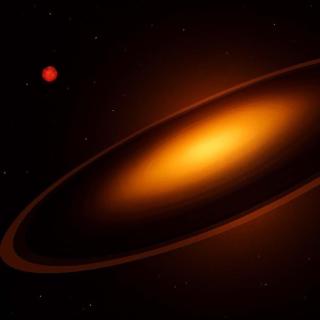

An international collaboration of astronomers led by the Universidad de La Laguna (ULL) and Instituto de Astrofísica de Canarias (IAC) has identified two intriguing, humongous but light planets orbiting HD 114082. This star is only 15 million years old, this is, much younger than the Sun (4.6 billion years old), spins 15 times faster, has 28% more mass, and is about one thousand degrees hotter and almost four times more luminous. Its planets receive about 200 times more light and heat than Jupiter. The study, which involved separating the faint planetary signal from the stellar one, offers clues about how exoplanets form and helps to contextualise the solar system.
Carlos del Burgo Díaz, employed as Beatriz Galindo Senior distinguished researcher at ULL, working at ULL and IAC, leads the study published today in Astrophysical Journal Letters, details the findings: “We have identified a strange pair of giant exoplanets. They stand out among the youngest detected by passing in front of their star because they take longer to complete an orbit. The inner planet, 20% closer to its star than Earth is to the Sun, has the Jupiter’s size. The outer planet is at the same orbital distance as Earth, and has a radius 36% larger than that of Jupiter and a mean density more than 7.5 times less than that of water, so it would float on it”. Alejandro Suárez Mascareño (ULL/IAC), coauthor of the paper, adds: “The planets move in almost circular orbits in the same plane, and may be in or near a resonance [which implies that the planetary orbital periods have a simple whole-number relationship].”
The study uses data taken with the TESS (Transiting Exoplanet Survey Satellite) and CHEOPS (CHaracterising ExOplanet Satellite) space telescopes, and ground-based facilities including NGTS (Next-Generation Transit Survey; Chile), ASTEP+ (Antarctic Search for Transiting ExoPlanets telescope; Antarctica) and Las CumbresObservatory (LCO). From these observations, stellar light curves (intensity versus time) were generated. They show four non-consecutive dips of the inner planet HD 114082 b. Every dip or transit is due to the planet passing in front of the star, blocking a small fraction of its light from our point of view. These data enabled thedetermination of its orbital period down to the minute. The period of the outer planet, HD 114082 c, of 314 days(margin of error of 9%), was estimated from a single transit confirmed with two instruments and supplementary measures.
The gravitational pull between the two planets reveals itself through a tug-of-war, which delays or advances the transit of the companion; the effect, all the more pronounced the closer to a resonance these giants are, can be measured even if their masses are small. Carlos del Burgo adds: “Following our discovery, the exoplanet community is expected to join the search for a second transit of the outer planet, which would allow us to pinpointits period. Once this is achieved, refining the masses of the two planets will require measuring the mid-transit times of several dips for each one. This method could also reveal additional bodies in the system.”
How and where did these planets form?
These giants formed within the protoplanetary disc, rich in gas and dust, around the star. They first accumulatedmaterial until they formed a solid core. When they reached a certain mass, a runaway gas accretion process began and the internal heat caused its envelope to expand. The theory suggests that two planets born in close proximity to each other tend to reach similar masses. The measured mass of the outer planet is at most 24% of Jupiter's, i.e., 4.4 times Neptune’s mass. The planets of HD 114082 could have formed in situ. Or, they formed in a distant, cold region, and migrated to their current orbits, where they receive more light and heat.
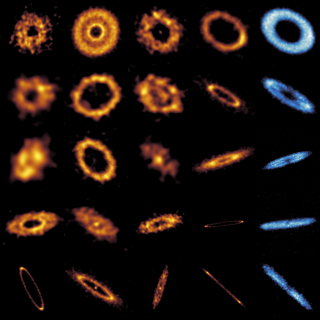
Carlos del Burgo explains: “These giants must have influenced the orbits of asteroids and comets [remnants of planetary formation] closest to the star, arranging them into a belt that lies in the same plane than the planets’ orbits.” Jonathan Marshall (ASIAA), co-author of the paper, adds: “Whereas the outer ring of icy dust grains and debris, located at a distance 25% greater than Neptune's orbit, is inclined with respect to the planetary orbits and likely primordial”.
Impact of the findings
The international collaboration led by ULL and IAC included 38 researchers. Efforts were coordinated to achieve data integration and coherent processing. The obtained findings place this planetary system around HD 114082 in the exoplanet community's spotlight. In the coming years, follow-up observations with facilities like those used in this work and others such as the James Webb Space Telescope, will allow this unique system to be characterised in greater detail, from pinpointing the masses of the planets to revealing their atmospheric chemical composition and other mysteries yet to be solved.
Article: C. del Burgo, et al. “The longest-period young transiting exoplanets — A duo of puffy giants inside a debris disc”, ApJ Letters, 2026. DOI: https://doi.org/10.3847/2041-8213/ae63bd
Contact email:
Carlos del Burgo Díaz, carlos.del.burgo [at] iac.es (carlos[dot]del[dot]burgo[at]iac[dot]es)