News

This section includes scientific and technological news from the IAC and its Observatories, as well as press releases on scientific and technological results, astronomical events, educational projects, outreach activities and institutional events.

  • Eva Villaver Sobrino / IAC
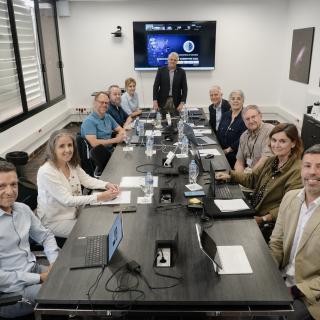
    Eva Villaver, Deputy Director of the Instituto de Astrofísica de Canarias (IAC), has been appointed by the European Space Agency (ESA) to the Space Science Advisory Committee (SSAC), the highest advisory body to ESA's Director of Science on all matters related to the organization's mandatory science program. This role complements Dr. Villaver's duties as Deputy Director of the IAC. The SSAC carries out a strategic oversight role, sitting above the specialized working groups in areas such as astronomy or solar system exploration. Furthermore, it is responsible for issuing recommendations on
    Advertised on
  • Artistic impression of a runaway star propelled by a supernova explosion
    Researchers from the Instituto de Astrofísica de Canarias (IAC), in collaboration with the Instituto de Ciencias del Cosmos de la Universidad de Barcelona (ICCUB) and the Instituto de Estudios Espaciales de Cataluña (IEEC), have carried out the largest observational study to date on massive runaway stars including rotation and binarity in the Milky Way. This work, recently published in Astronomy & Astrophysics , sheds light on how these stellar “fugitives” are launched into space and what their properties reveal about their intriguing origins. Runaway stars are stars that travel through
    Advertised on
  • MIT Astronomy Field Camp 2026
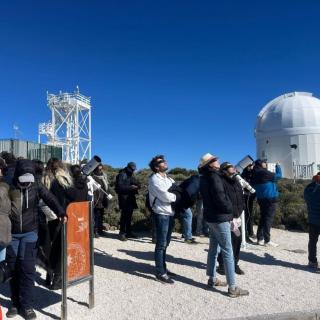
    This January, the Instituto de Astrofísica de Canarias hosted, for the fourth time, the MIT Astronomy Field Camp, the historic science camp that the Massachusetts Institute of Technology (MIT), considered one of the best and most influential universities in the world, offers its planetary science and astronomy students with the aim of providing them with real experience of working in a professional observatory. On this occasion, nine students spent three weeks at the Teide Observatory in Tenerife, where they carried out various astronomical observations. This activity, coordinated by MIT
    Advertised on
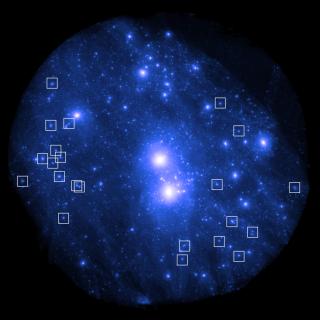
  • Comparison between an observed galaxy (right) and a simulated galaxy (left)
    In the standard cosmological model (𝜦CDM), galaxies are merely the visible "tips of the icebergs," residing within massive, invisible cocoons of dark matter known as haloes. While these haloes dictate the evolution and motion of galaxies, measuring their true size and mass has long been one of the most challenging tasks in astrophysics. A new study published in Astronomy & Astrophysics by Claudio Dalla Vecchia and Ignacio Trujillo from the Instituto de Astrofísica de Canarias (IAC) proposes a breakthrough: a physically motivated definition of a galaxy’s edge that acts as a precision "ruler"
    Advertised on
  • ARKS gallery of faint debris disks
    An international team, with participation from the University of La Laguna (ULL) and the Instituto de Astrofísica de Canarias (IAC), have, for the first time, captured a detailed snapshot of planetary systems in an era long shrouded in mystery. The study, called ALMA survey to Resolve exoKuiper belt Substructures (ARKS) , is based on a series of 10 articles published simultaneously in the journal Astronomy and Astrophysics and was carried out using the Atacama Large Millimetre/submillimetre Array (ALMA) . Thanks to this work, the sharpest images ever of 24 debris disks, the dusty belts left
    Advertised on
  • RGB image of the Ring Nebula obtained with WEAVE/LIFU
    Research carried out with the new WEAVE spectrograph, installed on the William Herschel Telescope (WHT) at the Roque de los Muchachos Observatory (La Palma), and in whose construction the Instituto de Astrofísica de Canarias (IAC) has participated, has found a mysterious bar-shaped cloud of iron inside the iconic Ring Nebula. The study was conducted by a European team led by astronomers at University College London (UCL) and Cardiff University, and includes researchers from the IAC. The cloud of iron atoms, described for the first time in Monthly Notices of the Royal Astronomical Society
    Advertised on