
Bibcode
Hakala, Pasi; Pelisoli, Ingrid; Gänsicke, Boris T.; Rodríguez-Gil, Pablo; Marsh, Thomas R.; Breedt, Elmé; Thorstensen, John R.; Pala, Anna F.
Bibliographical reference
Monthly Notices of the Royal Astronomical Society
Advertised on:
6
2025
Citations
1
Refereed citations
1
Description
We present the results of our study of ASASSN–14dx, a previously known but poorly characterized cataclysmic variable (CV). The source was observed as part of an ongoing high-time-resolution photometric survey of CVs, which revealed that, in addition to the known 82.8-min orbital period, it also exhibits other transient periods, the strongest of which around 4 and 14 min. Here, we report our findings resulting from a multifaceted follow-up programme consisting of optical spectroscopy, spectropolarimetry, imaging polarimetry, and multicolour fast photometry. We find that the source displays complex optical variability, which is best explained by the presence of a massive white dwarf exhibiting non-radial pulsations. An intermediate polar-like scenario involving a spinning magnetic white dwarf can be ruled out based on the detected changes in the observed periods. Based on our optical spectroscopy, we can constrain the mass and effective temperature of the white dwarf to be $\sim$1.1 $\mathrm{M}_{\odot }$ and 16 100 K, respectively. The overall intrinsic flux level of the source is unusually high, suggesting that there remains significant residual emission from the accretion disc and/or the white dwarf even ten years after the 2014 outburst. Finally, we cannot detect any spectroscopic signatures from the donor star, making ASASSN–14dx a possible period bouncer system evolving towards a longer orbital period.
Related projects
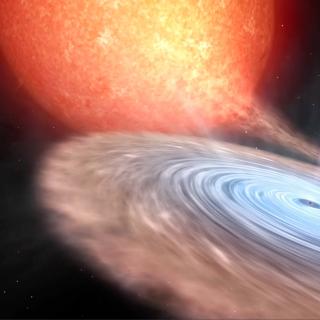
Black holes, neutron stars, white dwarfs and their local environment
Accreting black-holes and neutron stars in X-ray binaries provide an ideal laboratory for exploring the physics of compact objects, yielding not only confirmation of the existence of stellar mass black holes via dynamical mass measurements, but also the best opportunity for probing high-gravity environments and the physics of accretion; the most
Montserrat
Armas Padilla