
Bibcode
Shah, P.; Davis, T. M.; Vincenzi, M.; Armstrong, P.; Brout, D.; Camilleri, R.; Galbany, L.; García-Bellido, J.; Gill, M. S. S.; Lahav, O.; Lee, J.; Lidman, C.; Möller, A.; Sako, M.; Sánchez, B. O.; Sullivan, M.; Whiteway, L.; Wiseman, P.; Allam, S.; Aguena, M.; Bocquet, S.; Brooks, D.; Burke, D. L.; Carnero Rosell, A.; da Costa, L. N.; Pereira, M. E. S.; Desai, S.; Dodelson, S.; Doel, P.; Ferrero, I.; Flaugher, B.; Frieman, J.; Gaztanaga, E.; Gruen, D.; Gruendl, R. A.; Gutierrez, G.; Herner, K.; Hinton, S. R.; Hollowood, D. L.; Honscheid, K.; James, D. J.; Kuehn, K.; Lee, S.; Marshall, J. L.; Mena-Fernández, J.; Miquel, R.; Myles, J.; Palmese, A.; Pieres, A.; Plazas Malagón, A. A.; Roodman, A.; Samuroff, S.; Sanchez, E.; Sevilla-Noarbe, I.; Smith, M.; Suchyta, E.; Swanson, M. E. C.; Tarle, G.; To, C.; Vikram, V.; Weaverdyck, N.
Bibliographical reference
Monthly Notices of the Royal Astronomical Society
Advertised on:
1
2025
Citations
8
Refereed citations
7
Description
Gravitational lensing magnification of Type Ia supernovae (SNe Ia) allows information to be obtained about the distribution of matter on small scales. In this paper, we derive limits on the fraction $\alpha$ of the total matter density in compact objects (which comprise stars, stellar remnants, small stellar groupings, and primordial black holes) of mass M > 0.03 ${\rm M}_{\odot }$ over cosmological distances. Using 1532 SNe Ia from the Dark Energy Survey Year 5 sample (DES-SN5YR) combined with a Bayesian prior for the absolute magnitude M, we obtain α < 0.12 at the 95 per cent confidence level after marginalization over cosmological parameters, lensing due to large-scale structure, and intrinsic non-Gaussianity. Similar results are obtained using priors from the cosmic microwave background, baryon acoustic oscillations, and galaxy weak lensing, indicating our results do not depend on the background cosmology. We argue our constraints are likely to be conservative (in the sense of the values we quote being higher than the truth), but discuss scenarios in which they could be weakened by systematics of the order of $\Delta \alpha \sim 0.04$.
Related projects
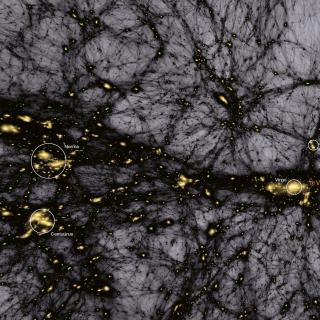
Cosmology with Large Scale Structure Probes
The Cosmic Microwave Background (CMB) contains the statistical information about the early seeds of the structure formation in our Universe. Its natural counterpart in the local universe is the distribution of galaxies that arises as a result of gravitational growth of those primordial and small density fluctuations. The characterization of the
Francisco Shu
Kitaura Joyanes