
Bibcode
Abbott, T. M. C.; Aguena, M.; Alarcon, A.; Amon, A.; Anbajagane, D.; Andrade-Oliveira, F.; Avila, S.; Allam, S. S.; Bacon, D.; Becker, M. R.; Bhargava, S.; Blazek, J.; Bocquet, S.; Brooks, D.; Carnero Rosell, A.; Carretero, J.; Castander, F. J.; Chang, C.; Choi, A.; Conselice, C.; Costanzi, M.; Crocce, M.; da Costa, L. N.; Pereira, M. E. S.; Doux, C.; Davis, T. M.; Desai, S.; Diehl, H. T.; Dodelson, S.; Doel, P.; Elvin-Poole, J.; Esteves, J.; Everett, S.; Farahi, A.; Ferté, A.; Flaugher, B.; García-Bellido, J.; Gatti, M.; Giannini, G.; Giles, P.; Grandis, S.; Gruen, D.; Gruendl, R. A.; Gutierrez, G.; Harrison, I.; Hinton, S. R.; Hollowood, D. L.; Honscheid, K.; Jeffrey, N.; Jeltema, T.; Krause, E.; Lahav, O.; Lee, S.; Lidman, C.; Lima, M.; Lin, H.; Mohr, J. J.; Marshall, J. L.; McCullough, J.; Mena-Fern'andez, J.; Miquel, R.; Muir, J.; Myles, J.; Ogando, R. L. C.; Palmese, A.; Paterno, M.; Malagón, A. A. Plazas; Porredon, A.; Prat, J.; Romer, A. K.; Roodman, A.; Rozo, E.; Rykoff, E. S.; Rosenfeld, R.; Sanchez, E.; Cid, D. Sanchez; Sevilla-Noarbe, I.; Smith, M.; Suchyta, E.; Shin, Tae-hyeon; Tarle, G.; Thomas, D.; To, Chun-Hao; Troxel, M. A.; Vikram, V.; Walker, A. R.; Weinberg, David H.; Weaverdyck, N.; Wechsler, R. H.; Weller, J.; Wu, H.-Y.; Yamamoto, M.; Yanny, B.; Zhang, Y.; Zhou, C.; DES Collaboration
Bibliographical reference
Physical Review D
Advertised on:
10
2025
Journal
Citations
62
Refereed citations
33
Description
Galaxy clusters provide a unique probe of the late-time cosmic structure and serve as a powerful independent test of the ΛCDM model. This work presents the first set of cosmological constraints derived with ∼16, 000 optically selected redMaPPer clusters across nearly 5000 deg2 using DES year 3 datasets. Our analysis leverages a consistent modeling framework for galaxy cluster cosmology and DES-Y3 joint analyses of galaxy clustering and weak lensing (3×2pt), ensuring direct comparability with the DES-Y3 3×2pt analysis. We obtain constraints of S8=0.864±0.035 and Ωm=0.265-0.031+0.019 from the cluster-based data vector. We find that cluster constraints and 3×2pt constraints are consistent under the ΛCDM model with a posterior predictive distribution (PPD) value of 0.53. The consistency between clusters and 3×2pt provides a stringent test of ΛCDM across different mass and spatial scales. Jointly analyzing clusters with 3×2pt further improves cosmological constraints, yielding S8=0.811-0.020+0.022 and Ωm=0.294-0.033+0.022, a 24% improvement in the Ωm-S8 figure of merit over 3×2pt alone. Moreover, we find no significant deviation from the Planck CMB constraints with a probability to exceed (PTE) value of 0.6, significantly reducing previous S8 tension claims. Finally, combining DES 3×2pt, DES clusters, and Planck CMB places an upper limit on the sum of neutrino masses of ∑mν<0.26 eV at 95% confidence under the ΛCDM model. These results establish optically selected clusters as a key cosmological probe and pave the way for cluster-based analyses in upcoming stage-IV surveys such as LSST, Euclid, and Roman.
Related projects
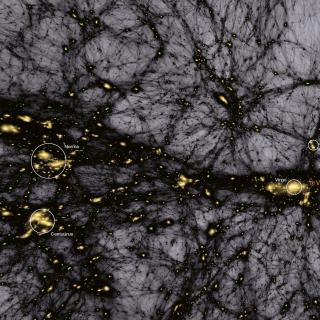
Cosmology with Large Scale Structure Probes
The Cosmic Microwave Background (CMB) contains the statistical information about the early seeds of the structure formation in our Universe. Its natural counterpart in the local universe is the distribution of galaxies that arises as a result of gravitational growth of those primordial and small density fluctuations. The characterization of the
Francisco Shu
Kitaura Joyanes