
Bibcode
Sarrato-Alós, J.; Brook, C.; Di Cintio, A.; Expósito-Márquez, J.; Huertas-Company, M.; Macciò, A. V.
Bibliographical reference
Astronomy and Astrophysics
Advertised on:
11
2025
Journal
Citations
4
Refereed citations
4
Description
Aims. Determining the dynamical mass profiles of dispersion-supported galaxies is particularly challenging due to projection effects and the unknown shape of their velocity anisotropy profile. Traditionally, this task relies on time-consuming methods that require profile parameterisation and the assumption of dynamical equilibrium and spherical symmetry. Methods. Our goal is to develop a machine-learning algorithm capable of recovering dynamical mass profiles of dispersion-supported galaxies from line-of-sight stellar data. Results. We trained a convolutional neural network model using various sets of cosmological hydrodynamical simulations of galaxies. By extracting projected stellar data from the simulated galaxies and feeding them into the model, we obtained the posterior distribution of the dynamical mass profile at ten different radii. Additionally, we evaluated the performance of existing literature mass estimators on our dataset. Conclusions. Our model achieves more accurate results than any literature mass estimator while also providing enclosed mass estimates at radii where no previous estimators exist. We confirm that the posterior distributions produced by the model are well calibrated, ensuring they provide meaningful uncertainties. However, issues remain: the method's performance is less good when trained on one set of simulations and applied to another, highlighting the importance of improving the generalisation of machine-learning methods trained on specific galaxy simulations.
Related projects
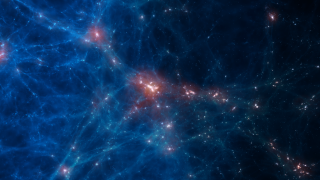
Numerical Astrophysics: Galaxy Formation and Evolution
How galaxies formed and evolved through cosmic time is one of the key questions of modern astronomy and astrophysics. Cosmological time- and length-scales are so large that the evolution of individual galaxies cannot be directly observed. Only through numerical simulations can one follow the emergence of cosmic structures within the current
Claudio
Dalla Vecchia