
Bibcode
Mata Sánchez, D.; Torres, M. A. P.; Casares, J.; Muñoz-Darias, T.; Armas Padilla, M.; Yanes-Rizo, I. V.
Bibliographical reference
Astronomy and Astrophysics
Advertised on:
1
2025
Journal
Citations
40
Refereed citations
37
Description
The X-ray transient Swift J1727.8‑1613 ended its 10-month discovery outburst in June of 2024, when it reached an optical brightness comparable to pre-discovery magnitudes. With the aim of performing a dynamical study, we launched an optical spectroscopy campaign with the GTC telescope. We detected the companion star and constructed its radial velocity curve, yielding a binary orbital period of Porb = 10.8038 ± 0.0010 h and a radial velocity semi-amplitude of K2 = 390 ± 4 km s‑1. This results in a mass function of f(M1) = 2.77 ± 0.09 M⊙. Combined with constraints on the binary inclination, it sets a lower limit on the compact object mass of M1 > 3.12 ± 0.10 M⊙, dynamically confirming the black hole nature of the accretor. A comparison of the average spectrum in the rest frame of the companion with synthetic stellar templates supports a K4V donor that is partially (74%) veiled by the accretion disc. A refined distance measurement of 3.4 ± 0.3 kpc, together with the astrometric proper motion and the systemic velocity derived from the radial velocity curve (γ = 181 ± 4 km s‑1), supports a natal kick velocity of vkick = 210‑50+40 km s‑1, at the upper end of the observed distribution.
Related projects
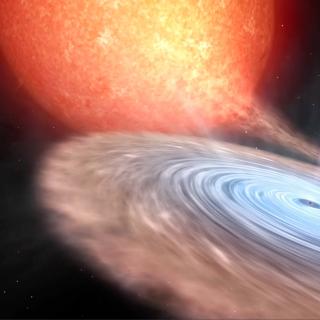
Black holes, neutron stars, white dwarfs and their local environment
Accreting black-holes and neutron stars in X-ray binaries provide an ideal laboratory for exploring the physics of compact objects, yielding not only confirmation of the existence of stellar mass black holes via dynamical mass measurements, but also the best opportunity for probing high-gravity environments and the physics of accretion; the most
Montserrat
Armas Padilla