
Bibcode
Stefanov, A. K.; Suárez Mascareño, A.; González Hernández, J. I.; Nari, N.; Rebolo, R.; Affer, L.; Micela, G.; Ribas, I.; Sozzetti, A.; Perger, M.; Pinamonti, M.; Damasso, M.; Maldonado, J.; González Álvarez, E.; Scandariato, G.
Bibliographical reference
Astronomy and Astrophysics
Advertised on:
3
2025
Journal
Citations
4
Refereed citations
4
Description
The low masses of M dwarfs create attractive opportunities for exoplanet radial-velocity (RV) detections. These stars, however, exhibit strong stellar activity that may attenuate or mimic planetary signals. We present a velocimetric analysis of one such M dwarf, GJ 3998 (d = 18.2 pc), with two published short-period super-Earths: GJ 3998 b and GJ 3998 c. We use additional data from the HARPS-N spectrograph to confirm these two planets and to look for more. We carry out joint modelling of: (i) RV planetary signals, (ii) stellar rotation in RV and activity indicators through Gaussian processes, and (iii) long-term trends in RV and activity indicators. We constrain the rotational period of GJ 3998 to Prot = 30.2 ± 0.3 d and discover long-term sinusoidal imprints in RV and the full width at half maximum with a period of Pcyc = 316‑8+14 d. We confirm GJ 3998 b and GJ 3998 c, and detect a third planet: GJ 3998 d, whose signal had previously been attributed to stellar activity. GJ 3998 d has an orbital period of 41.78 ± 0.05 d, a minimum mass of 6.07‑0.96+1.00 M⊕, and a mean insolation flux of 1.2‑0.2+0.3 Φ⊕. This makes it one of the few known planets receiving an Earth-like insolation flux.
Related projects
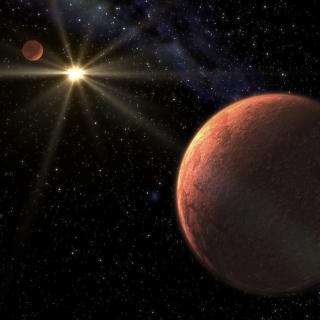
Very Low Mass Stars, Brown Dwarfs and Planets
Our goal is to study the processes that lead to the formation of low mass stars, brown dwarfs and planets and to characterize the physical properties of these objects in various evolutionary stages. Low mass stars and brown dwarfs are likely the most numerous type of objects in our Galaxy but due to their low intrinsic luminosity they are not so
Rafael
Rebolo López