
Bibcode
Eyles-Ferris, Rob A. J.; Jonker, Peter G.; Levan, Andrew J.; Malesani, Daniele Bjørn; Sarin, Nikhil; Fryer, Christopher L.; Rastinejad, Jillian C.; Burns, Eric; Tanvir, Nial R.; O'Brien, Paul T.; Fong, Wen-fai; Mandel, Ilya; Gompertz, Benjamin P.; Kilpatrick, Charles D.; Bloemen, Steven; Bright, Joe S.; Carotenuto, Francesco; Corcoran, Gregory; Cotter, Laura; Groot, Paul J.; Izzo, Luca; Laskar, Tanmoy; Martin-Carrillo, Antonio; Palmerio, Jesse; Ravasio, Maria E.; van Roestel, Jan; Saccardi, Andrea; Starling, Rhaana L. C.; Thakur, Aishwarya Linesh; Vergani, Susanna D.; Vreeswijk, Paul M.; Bauer, Franz E.; Campana, Sergio; Chacón, Jennifer A.; Chrimes, Ashley A.; Covino, Stefano; van Dalen, Joyce N. D.; D'Elia, Valerio; De Pasquale, Massimiliano; Habeeb, Nusrin; Hartmann, Dieter H.; van Hoof, Agnes P. C.; Jakobsson, Páll; Julakanti, Yashaswi; Leloudas, Giorgos; Mata Sánchez, Daniel; Nixon, Christopher J.; Pieterse, Daniëlle L. A.; Pugliese, Giovanna; Quirola-Vásquez, Jonathan; Rayson, Ben C.; Salvaterra, Ruben; Schneider, Ben; Torres, Manuel A. P.; Zafar, Tayyaba
Bibliographical reference
The Astrophysical Journal
Advertised on:
7
2025
Journal
Citations
45
Refereed citations
38
Description
Fast X-ray transients are a rare and poorly understood population of events. Previously difficult to detect in real time, the launch of the Einstein Probe with its Wide-field X-ray Telescope has led to a rapid expansionof the sample and allowed the exploration of these transients across the electromagnetic spectrum. EP250108a is a recently detected example linked to an optical counterpart, SN 2025kg, or "the kangaroo." Together with a companion Letter we present our observing campaign and analysis of this event. In this letter, we focus on the early evolution of the optical counterpart over the first 6 days, including our measurement of the redshift of z = 0.17641. We compare to other supernovae and fast transients showing similar features, finding significant similarities with SN 2006aj and SN 2020bvc, and show that the source is well modelled by a rapidly expanding cooling blackbody. We show the observed X-ray and radio properties are consistent with a collapsar-powered jet that is low energy (≲1051 erg) and/or fails to break out of the dense material surrounding it. While we examine the possibility that the optical emission emerges from the shock produced as the supernova ejecta expand into a dense shell of circumstellar material, due to our X-ray and radio inferences, we favour a model where it arises from a shocked cocoon resulting from a trapped jet. This makes SN 2025 one of the few examples of this currently observationally rare event.
Related projects
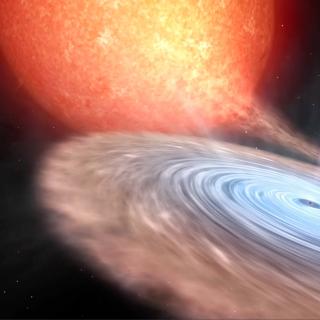
Black holes, neutron stars, white dwarfs and their local environment
Accreting black-holes and neutron stars in X-ray binaries provide an ideal laboratory for exploring the physics of compact objects, yielding not only confirmation of the existence of stellar mass black holes via dynamical mass measurements, but also the best opportunity for probing high-gravity environments and the physics of accretion; the most
Montserrat
Armas Padilla