
Bibcode
Burgasser, Adam J.; Gonzales, Eileen C.; Beiler, Samuel A.; Visscher, Channon; Burningham, Ben; Mace, Gregory N.; Faherty, Jacqueline K.; Zhang, Zenghua; Sousa-Silva, Clara; Lodieu, Nicolas; Metchev, Stanimir A.; Meisner, Aaron; Cushing, Michael; Schneider, Adam C.; Suarez, Genaro; Hsu, Chih-Chun; Gerasimov, Roman; Aganze, Christian; Theissen, Christopher A.
Bibliographical reference
Science
Advertised on:
11
2025
Journal
Citations
18
Refereed citations
15
Description
The atmospheres of low-temperature brown dwarfs and gas giant planets are expected to contain the phosphine molecule, PH3. However, previous observations have shown much lower abundances of this molecule than predicted with atmospheric chemistry models. We report JWST spectroscopic observations of phosphine in the atmosphere of the brown dwarf Wolf 1130C. Multiple absorption lines due to phosphine have been detected around 4.3 micrometers, from which we calculated a phosphine abundance of 0.100 ± 0.009 parts per million. This abundance is consistent with disequilibrium atmospheric chemistry models that reproduced the phosphine abundances in Jupiter and Saturn and is much higher than abundances previously reported for other brown dwarfs or exoplanets. This difference may be related to the low abundance of elements heavier than helium in Wolf 1130C.
Related projects
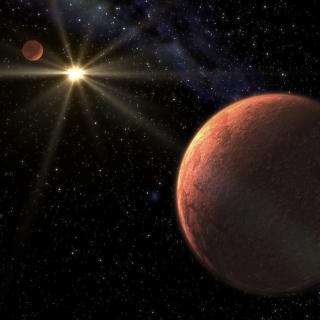
Very Low Mass Stars, Brown Dwarfs and Planets
Our goal is to study the processes that lead to the formation of low mass stars, brown dwarfs and planets and to characterize the physical properties of these objects in various evolutionary stages. Low mass stars and brown dwarfs are likely the most numerous type of objects in our Galaxy but due to their low intrinsic luminosity they are not so
Rafael
Rebolo López