
Bibcode
Lasker, J.; Carnero Rosell, A.; Myers, A. D.; Ross, A. J.; Bianchi, D.; Hanif, M. M. S.; Kehoe, R.; de Mattia, A.; Napolitano, L.; Percival, W. J.; Staten, R.; Aguilar, J.; Ahlen, S.; Bigwood, L.; Brooks, D.; Claybaugh, T.; Cole, S.; de la Macorra, A.; Ding, Z.; Doel, P.; Fanning, K.; Forero-Romero, J. E.; Gaztañaga, E.; Gontcho A Gontcho, S.; Gutierrez, G.; Honscheid, K.; Howlett, C.; Juneau, S.; Kremin, A.; Landriau, M.; Le Guillou, L.; Levi, M. E.; Manera, M.; Meisner, A.; Miquel, R.; Moustakas, J.; Mueller, E.; Nie, J.; Niz, G.; Oh, M.; Palanque-Delabrouille, N.; Poppett, C.; Prada, F.; Rezaie, M.; Rossi, G.; Sanchez, E.; Schlegel, D.; Schubnell, M.; Seo, H.; Sprayberry, D.; Tarlé, G.; Vargas-Magaña, M.; Weaver, B. A.; Wilson, Michael J.; Zheng, Y.; DESI Collaboration
Bibliographical reference
Journal of Cosmology and Astroparticle Physics
Advertised on:
1
2025
Citations
36
Refereed citations
33
Description
A critical requirement of spectroscopic large scale structure analyses is correcting for selection of which galaxies to observe from an isotropic target list. This selection is often limited by the hardware used to perform the survey which will impose angular constraints of simultaneously observable targets, requiring multiple passes to observe all of them. In SDSS this manifested solely as the collision of physical fibers and plugs placed in plates. In DESI, there is the additional constraint of the robotic positioner which controls each fiber being limited to a finite patrol radius. A number of approximate methods have previously been proposed to correct the galaxy clustering statistics for these effects, but these generally fail on small scales. To accurately correct the clustering we need to upweight pairs of galaxies based on the inverse probability that those pairs would be observed (Bianchi & Percival 2017). This paper details an implementation of that method to correct the Dark Energy Spectroscopic Instrument (DESI) survey for incompleteness. To calculate the required probabilities, we need a set of alternate realizations of DESI where we vary the relative priority of otherwise identical targets. These realizations take the form of alternate Merged Target Ledgers (AMTL), the files that link DESI observations and targets. We present the method used to generate these alternate realizations and how they are tracked forward in time using the real observational record and hardware status, propagating the survey as though the alternate orderings had been adopted. We detail the first applications of this method to the DESI One-Percent Survey (SV3) and the DESI year 1 data. We include evaluations of the pipeline outputs, estimation of survey completeness from this and other methods, and validation of the method using mock galaxy catalogs.
Related projects
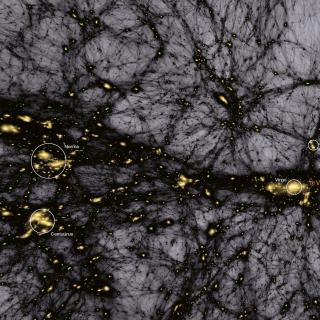
Cosmology with Large Scale Structure Probes
The Cosmic Microwave Background (CMB) contains the statistical information about the early seeds of the structure formation in our Universe. Its natural counterpart in the local universe is the distribution of galaxies that arises as a result of gravitational growth of those primordial and small density fluctuations. The characterization of the
Francisco Shu
Kitaura Joyanes