
Bibcode
Yanes-Rizo, I. V.; Torres, M. A. P.; Casares, J.; Jonker, P. G.; Sánchez-Sierras, J.; Muñoz-Darias, T.; Armas Padilla, M.
Bibliographical reference
Astronomy and Astrophysics
Advertised on:
2
2025
Journal
Citations
7
Refereed citations
6
Description
We present time-resolved Gran Telescopio Canarias optical spectroscopy and William Herschel Telescope i-band photometry of the X-ray transient SWIFT J1753.5–0127 in quiescence. The i-band light curve is dominated by flickering with an amplitude of ∼0.5 mag and shows no evidence of the ellipsoidal modulation of the companion star. The telluric-corrected average spectrum, on the other hand, reveals the presence of weak (strongly veiled) TiO bands at 7055 Å and 7589 Å. We used them for a spectral classification, finding an M4-5 V companion star. However, as velocity shifts are not clearly detected in the individual spectra, we turned the analysis to the double-peaked Hα emission line from the accretion disc. By exploiting the empirical correlations established for quiescent X-ray transients between the line morphology and fundamental binary parameters, we estimated the radial velocity semi-amplitude of the companion K2 = 820 ± 36 km s‑1, a mass ratio q = 0.023 ± 0.006 and an inclination i = 79 ± 5 deg. Moreover, an orbital period of 3.26 ± 0.02 h was measured from the modulation of the centroid velocities and the double-peak trough depth of the Hα profile. These quantities yielded a mass function f(M1) = 7.8 ± 1.0 M⊙ and black hole and companion star masses of M1 = 8.8 ± 1.3 M⊙ and M2 = 0.20 ± 0.06 M⊙, respectively. The companion star mass is in line with the spectral classification obtained from the relative depth of the TiO bands. Based on the mean quiescent magnitude (i = 21.4 ± 0.1), orbital period, and interstellar extinction, we estimate the distance to the source to be 3.9 ± 0.7 kpc and a Galactic plane elevation of 0.8 ± 0.2 kpc, supporting the case for a large natal kick.
Related projects
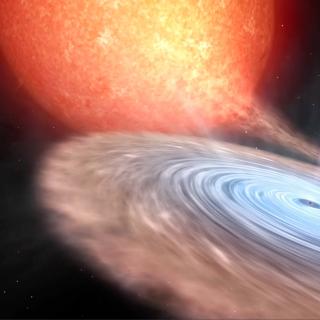
Black holes, neutron stars, white dwarfs and their local environment
Accreting black-holes and neutron stars in X-ray binaries provide an ideal laboratory for exploring the physics of compact objects, yielding not only confirmation of the existence of stellar mass black holes via dynamical mass measurements, but also the best opportunity for probing high-gravity environments and the physics of accretion; the most
Montserrat
Armas Padilla