
Bibcode
Faherty, Jacqueline K.; Meisner, Aaron M.; Burningham, Ben; Visscher, Channon; Line, Michael; Suárez, Genaro; Gagné, Jonathan; Alejandro Merchan, Sherelyn; Rothermich, Austin James; Burgasser, Adam J.; Schneider, Adam C.; Caselden, Dan; Kirkpatrick, J. Davy; Kuchner, Marc Jason; Bardalez Gagliuffi, Daniella Carolina; Eisenhardt, Peter; Gelino, Christopher R.; Gonzales, Eileen C.; Marocco, Federico; Leggett, Sandy; Lodieu, Nicolas; Casewell, Sarah L.; Tremblin, Pascal; Cushing, Michael; Zapatero Osorio, Maria Rosa; Béjar, Víctor J. S.; Gauza, Bartosz; Wright, Edward; Phillips, Mark W.; Zhang, Jun-Yan; Martin, Eduardo L.
Bibliographical reference
Nature
Advertised on:
9
2025
Journal
Citations
17
Refereed citations
15
Description
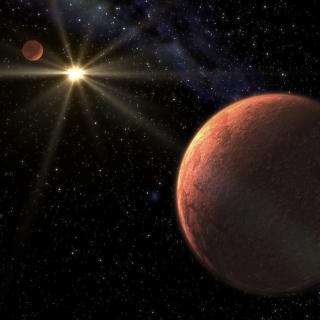
Within 20 pc of the Sun, there are currently 29 known cold brown dwarfs—sources with measured distances and an estimated effective temperature between that of Jupiter (170 K) and approximately 500 K (ref. 1). These sources are almost all isolated and are the closest laboratories we have for detailed atmospheric studies of giant planets formed outside the Solar System. Here we report JWST observations of one such source, WISEA J153429.75-104303.3 (W1534), which we confirm is a substellar mass member of the Galactic halo with a metallicity of less than 0.01 times solar. Its spectrum reveals methane (CH4), water (H2O) and silane (SiH4) gas. Although SiH4 is expected to serve as a key reservoir for the cloud-forming element Si in gas giant worlds, it has remained undetected until now because it is removed from observable atmospheres by the formation of silicate clouds at depth. These condensates are favoured with increasing metallicity, explaining why SiH4 remains undetected on well-studied metal-rich Solar System worlds such as Jupiter and Saturn2. On the metal-poor world W1534, we detect a clear signature of SiH4 centred at about 4.55 μm with an abundance of 19 ± 2 parts per billion. Our chemical modelling suggests that this SiH4 abundance may be quenched at approximately kilobar levels just above the silicate cloud layers, in which vertical atmospheric mixing can transport SiH4 to the observable photosphere. The formation and detection of SiH4 demonstrates key coupled relationships between composition, cloud formation and atmospheric mixing in cold brown dwarf and planetary atmospheres.
Related projects
Very Low Mass Stars, Brown Dwarfs and Planets
Our goal is to study the processes that lead to the formation of low mass stars, brown dwarfs and planets and to characterize the physical properties of these objects in various evolutionary stages. Low mass stars and brown dwarfs are likely the most numerous type of objects in our Galaxy but due to their low intrinsic luminosity they are not so
Rafael
Rebolo López

Exoplanets and Astrobiology
The search for life in the universe has been driven by recent discoveries of planets around other stars (known as exoplanets), becoming one of the most active fields in modern astrophysics. The growing number of new exoplanets discovered in recent years and the recent advance on the study of their atmospheres are not only providing new valuable
Enric
Pallé Bago