
Bibcode
Šubjak, Ján; Gandolfi, Davide; Goffo, Elisa; Rapetti, David; Jankowski, Dawid; Mizuki, Toshiyuki; Dai, Fei; Serrano, Luisa M.; Wilson, Thomas G.; Goździewski, Krzysztof; Nowak, Grzegorz; Jenkins, Jon M.; Twicken, Joseph D.; Winn, Joshua N.; Bieryla, Allyson; Ciardi, David R.; Cochran, William D.; Collins, Karen A.; Deeg, Hans J.; García, Rafael A.; Guenther, Eike W.; Hatzes, Artie P.; Kabáth, Petr; Korth, Judith; Latham, David W.; Livingston, John H.; Lund, Michael B.; Mathur, Savita; Narita, Norio; Orell-Miquel, Jaume; Pallé, Enric; Persson, Carina M.; Redfield, Seth; Schwarz, Richard P.; Watanabe, David; Ziegler, Carl
Bibliographical reference
Astronomy and Astrophysics
Advertised on:
1
2025
Journal
Citations
5
Refereed citations
4
Description
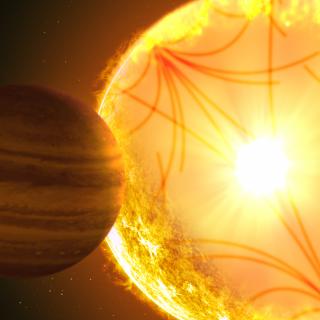
We report on the discovery and spectroscopic confirmation of TOI-2458 b, a transiting mini-Neptune around an F-type star leaving the main-sequence with a mass of M★ = 1.05 ± 0.03 M⊙, a radius of R★ = 1.31 ± 0.03 R⊙, an effective temperature of Teff = 6005 ± 50 K, and a metallicity of ‑0.10 ± 0.05 dex. By combining TESS photometry with high-resolution spectra acquired with the HARPS spectrograph, we found that the transiting planet has an orbital period of ‑3.74 days, a mass of Mp = 13.31 ± 0.99 M⊕ and a radius of Rp = 2.83 ± 0.20 R⊕. The host star TOI-2458 shows a short activity cycle of ~54 days revealed in the HARPS S-index and Ha times series. We took the opportunity to investigate other F stars showing activity cycle periods comparable to that of TOI-2458 and found that they have shorter rotation periods than would be expected based on the gyrochronology predictions. In addition, we determined TOI-2458's stellar inclination angle to be i* = 10.6‑10.6+13.3 degrees. We discuss that both phenomena (fast stellar rotation and planet orbit inclination) could be explained by in situ formation of a hot Jupiter interior to TOI-2458 b. It is plausible that this hot Jupiter was recently engulfed by the star. Analysis of HARPS spectra has identified the presence of another planet with a period of P = 16.55 ± 0.06 days and a minimum mass of Mp sin i = 10.22 ± 1.90 M⊕. Using dynamical stability analysis, we constrained the mass of this planet to the range Mc ≃ (10, 25) M⊕.
Related projects
Helio and Astero-Seismology and Exoplanets Search
The principal objectives of this project are: 1) to study the structure and dynamics of the solar interior, 2) to extend this study to other stars (either single or in binary systems), 3) to search for extrasolar planets using photometric methods (primarily by transits of their host stars) and their characterization with complementary radial
Savita
Mathur

Exoplanets and Astrobiology
The search for life in the universe has been driven by recent discoveries of planets around other stars (known as exoplanets), becoming one of the most active fields in modern astrophysics. The growing number of new exoplanets discovered in recent years and the recent advance on the study of their atmospheres are not only providing new valuable
Enric
Pallé Bago