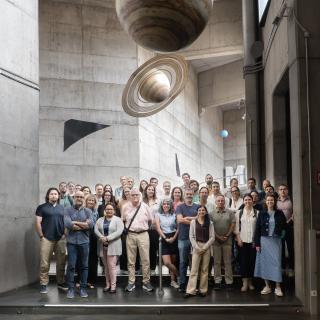

The National Hub of Excellence in Quantum Communications held its general meeting on 10 and 11 February at the IACTEC building, located in the Tenerife Science and Technology Park. The event brought together representatives from Spain’s leading public institutions in the field of quantum technologies, consolidating the coordinated efforts undertaken within this strategic initiative.
On Tuesday, 10 February, the programme addressed the Hub’s strategic vision within the national and European context, highlighting its alignment with Spain’s Quantum Technologies Strategy (2025–2030) and with initiatives such as EuroQCI. The institutional opening focused on the Hub’s role as a key instrument to strengthen Spain’s position in the development of advanced infrastructures and solutions in quantum communications.
Throughout the morning and afternoon, the participating entities presented their scientific and technological advances. Among these were the Q-ANSER mission as an inter-satellite QKD link demonstrator; the involvement of the Spanish National Research Council (CSIC) within the Hub; the developments driven by the Canary Islands Institute of Astrophysics (IAC), including the CELESTE project and the IAClink infrastructure for R&D in free-space optical communications; as well as the progress made by the University of Vigo, the Polytechnic University of Valencia and the Polytechnic University of Madrid in various work packages and regional ecosystems.
Key topics such as the hybridisation of classical and quantum networks and progress in the design of entangled photon sources prepared for satellite deployment were also discussed, highlighting the applied and collaborative nature of the Hub. All these efforts aim to integrate current communication networks with new quantum technologies that enable the transmission of information with unprecedented security. Furthermore, the development of free-space optical communication systems for satellite deployment opens the door to creating ultra-secure links between countries and continents — connections that cannot be achieved through traditional optical fibres due to their inherent losses.
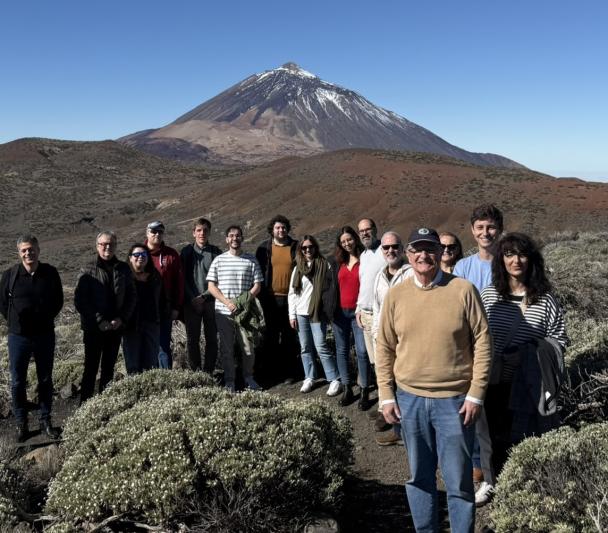
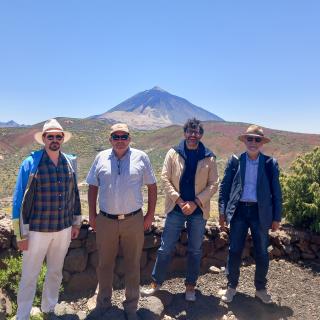
The second day, held on Wednesday, 11 February, included a visit to the Teide Observatory (OT), with a tour of its scientific facilities. A central part of the visit was the Optical Ground Station (OGS) of the European Space Agency (ESA). This activity allowed participants to learn first-hand about the OT’s strategic capabilities for the development of free-space optical communications and future ground-to-space quantum links.
Luis Fernando Rodríguez Ramos, Principal Investigator of the IAC’s Free-Space Optical Communications line, emphasised that “it has been an honour for the IAC to host this Hub meeting, of which it is a member alongside other Spanish public institutions engaged in quantum communications, both in free-space and optical fibre domains.”
A coordinated ecosystem to lead quantum communications
The National Hub of Excellence in Quantum Communications was created as an initiative aimed at reinforcing coordination among leading public research institutions in this field, fostering technological maturity, the development of use cases with industry, the training of specialised professionals, and the international projection of the Spanish ecosystem.
Framed within Spain’s Quantum Technologies Strategy (2025–2030) and aligned with European objectives, the Hub contributes to strengthening technological sovereignty and positioning Spain as a key player in the development of secure communication infrastructures based on quantum technologies.
The meeting held at IACTEC served to consolidate joint lines of work, assess progress and define upcoming milestones, reaffirming the participating entities’ commitment to the coordinated development of scientific and technological capabilities that will place Spain at the forefront of quantum communications internationally.