News

This section includes scientific and technological news from the IAC and its Observatories, as well as press releases on scientific and technological results, astronomical events, educational projects, outreach activities and institutional events.

  • Artist's impression of GJ 3998 d, a super-Earth in the habitable zone of its star
    An international team, led by a student from Instituto de Astrofísica de Canarias (IAC), has detected a super-Earth orbiting in the habitable zone of GJ 3998, a nearby red dwarf located 59 ly away. The new planet, named GJ 3998 d, is the third planet found in the system. ‘GJ 3998 d is a welcome addition to the planetary census of our cosmic neighbourhood’, states Atanas Stefanov, a "La Caixa" funded PhD student at the IAC and the University of La Laguna (ULL) and the study’s lead author, published in Astronomy & Astrophysics . 'This super-Earth appears to be in the habitable zone of one of
    Advertised on
  • Recreación artística del sistema planetario HD 176986
    An international scientific team led by the Instituto de Astrofísica de Canarias (IAC) has identified a new super-Earth orbiting the star HD 176986, a K-type dwarf located about 91 light-years away. The finding, published in the journal Astronomy and Astrophysics, brings the number of known planets in this system to three and confirms the value of long-term observation campaigns for detecting small, wide-orbiting worlds. The observation campaign of HD 176986, an orange dwarf star or K-type star, slightly smaller than the Sun and located about 91 light-years away, has highlighted the
    Advertised on
  • Gran Telescopio Canarias (GTC or Grantecan) at the Roque de los Muchachos Observatory on La Palma
    The Solar System research group at the Instituto de Astrofísica de Canarias (IAC) is participating in the international programme to keep a closet track of asteroid 2024 YR4. The aim is to determine its orbit with the highest possible precision before it stops being observable by ground based and satellite telescopes in April, and so improving our value of the probability that it will impact the Earth in 2032. In this context several telescopes of the Canary Observatories of the IAC are playing an outstanding role in this observing campaign: The Gran Telescopio Canarias (GTC) at the Roque de
    Advertised on
  • Artist impression of a planetary system with four planets, around a small red star, called LHS1903
    An international scientific team, led by the University of Warwick and involving the Canary Islands Institute of Astrophysics, has used the European Space Agency's Cheops satellite to discover that the planetary system around the star LHS 1903 challenges current planet formation theories with the unusual order of its planets. Surprisingly, the most distant outer planet might be rocky and seems to have formed later – in a different environment than the other planets around the star. The study is published in the prestigious journal Science. In our Solar System, the inner planets (Mercury to
    Advertised on
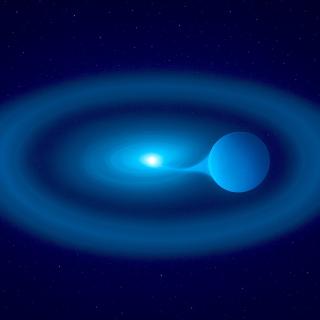
  • In this artist’s rendering, a stream of matter trails a white dwarf (sphere at lower right) orbiting within the innermost accretion disk surrounding 1ES 1927’s supermassive black hole. Credit: NASA/Aurore Simonnet, Sonoma State University
    The Instituto de Astrofísica de Canarias (IAC) participates in the study of a galaxy that hosts a supermassive black hole with previously unseen characteristics. The source is 1ES 1927+654, a galaxy located about 270 million light-years away in the constellation Draco. It harbors a central black hole with a mass equivalent to about 1.4 million Suns. “In 2018, the black hole began changing its properties right before our eyes, with a major optical, ultraviolet, and X-ray outburst,” said Eileen Meyer, an associate professor at UMBC (University of Maryland Baltimore County). “Many teams have
    Advertised on
  • Image of the planetary nebula WeSb1 / Credit: Klaus Bernhard
    An international team of researchers, including staff from the Instituto de Astrofísica de Canarias (IAC), has discovered a planetary nebula that destroyed its own planetary system, conserving the remaining fragments in the form of dust orbiting its central star. To date, more than 5000 exoplanets have been discovered orbiting stars of all kinds and almost every stage of stellar evolution. However, while exoplanets have been discovered around white dwarfs – the final stage in the evolution of low- and intermediate-mass stars like the Sun, no exoplanets have been detected in the previous
    Advertised on