Chemical Abundances in Stars

Start year
2010
Organizational Unit
    General
    Description

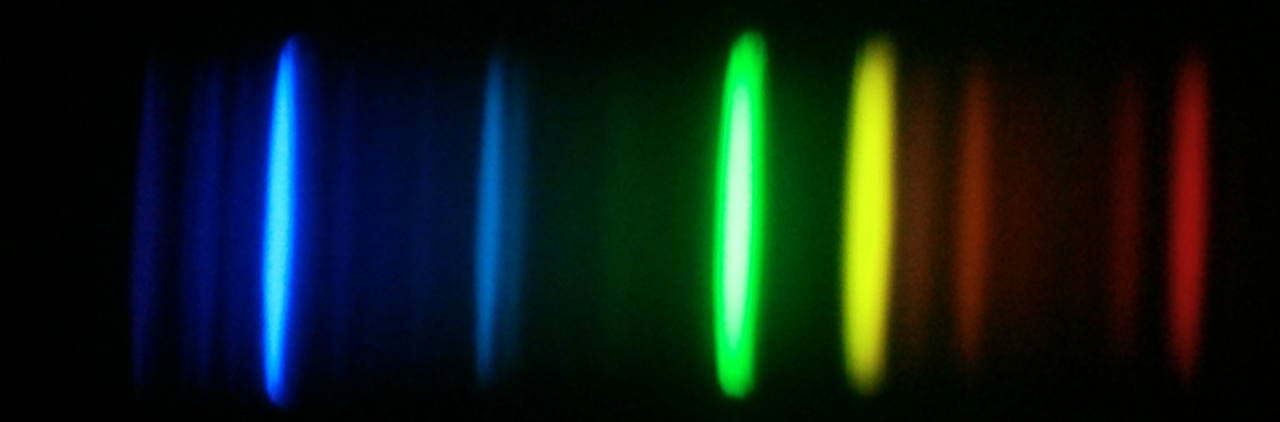
    Stellar spectroscopy allows us to determine the properties and chemical compositions of stars. From this information for stars of different ages in the Milky Way, it is possible to reconstruct the chemical evolution of the Galaxy, as well as the origin of the elements heavier than boron, created mainly in stellar interiors. It is also possible to study stellar formation, and the formation of the Galaxy, from the signature of the Galactic potential on the stellar orbits, and the distributions of mass, ages, and the abundance of heavy elements.

    Obtaining high-resolution spectra, as necessary for studies of chemical compositions, requires advanced and efficient instrumentation. This is particularly true for research that calls for large stellar samples, which demands the observation of hundreds or thousands of sources simultaneously. Efficiency requires that the data processing and analysis are performed in an automated way.

    The interpretation of spectra is based on physical models of the atmospheres of the stars, from where the light that we observe escapes the stars. The main ingredients for building such models are the fluid dynamics, and the properties of the atoms, ions, and molecules, especially regarding their interactions with the radiation coming from the stellar interior.

    Once we have a plausible model, it is possible to compute in detail how the radiation propagates through the stellar atmosphere, and the emergent spectrum, which can then be iteratively compared with the observations to refine the model.

    This project covers three different research fronts:

    - Improving model atmospheres and simulations of stellar spectra.

    - Developing tools for acquisition, reduction, and analysis of spectroscopic observations, in particular for the determination of chemical abundances in stars.

    - Designing, preparing, and executing spectroscopic studies of stars aimed at understanding a) the most relevant aspects of the physics of stellar atmospheres, b) the formation and evolution of stars, c) the origin of the chemical elements, and d) the formation, structure, and evolution of the Milky Way galaxy.

    Principal investigator
    Collaborators
    Dr.
    I. Hubeny
    Dr.
    B. Castanheira
    Dr.
    M. Kilic
    Dr.
    S. Majewski
    Dr.
    H.G. Ludwig
    Dr.
    M. Cropper
    Dr.
    M. P. Ruffoni
    Dr.
    J. C. Pickering
    Dr.
    K. Cunha
    Dr.
    Andrew Cooper
    Dr.
    Boris Gaensicke
    1. Complete the installation and commissioning of HORuS on GTC
    2. Discover two new stars with more than 100,000 times less iron than the Sun
    3. Complete the classification of all the APOGEE spectra with K-means
    4. Publish a complete collection of model stellar spectra for stars O to M
    5. Identify the signature of chemical diffusion in the atmospheres of the stars in the cluster M67

    Related publications

    Investigating episodic mass loss in evolved massive stars: IV. Comprehensive analysis of dusty red supergiants in NGC 6822, IC 10, and WLM 2025A&A...704A..96C
    The WEAVE-TwiLight-Survey: expanding WEAVE's reach to bright and low-surface-density targets with a novel observing mode 2025RASTI...4af060H
    Unveiling the nature of HE 0107─5240: a long period binary CEMP-no star with [Fe/H] of ─5.56 2025A&A...704A.238C
    On the Origin of Neutron-capture Elements in r-I and r-II Stars: A Differential-abundance Analysis 2025ApJ...994...78S
    A second low-mass planet orbiting the nearby M-dwarf GJ 536 2025A&A...702A.121S
    Mapping the Milky Way with Gaia BP/RP Spectra. III. The First Medium-resolution Follow-up Spectroscopy of Metal-poor Stars<SUP></SUP> 2025AJ....170..251Y
    Technetium-rich M stars: Prime diagnostics of recent third dredge-up events on the asymptotic giant branch 2025A&A...702A..39S
    Caveats about measuring carbon abundances in stars using the CH band 2025A&A...701A..95S
    SpecDis: Value Added Distance Catalog for 4 Million Stars from DESI Year-1 Data 2025AJ....170..171L
    Tidal Debris Candidates from the ω Centauri Accretion Event and Its Role Building Up the Milky Way Halo 2025ApJ...989...12A
    Exploring the interaction between the MW and LMC with a large sample of blue horizontal branch stars from the DESI survey 2025MNRAS.542..560B
    Mapping the Milky Way with Gaia Bp/Rp spectra: II. The inner stellar halo traced by a large sample of blue horizontal branch stars 2025A&A...700A.244W
    C-19 and Hot, Wide Star Streams 2025ApJ...988...96C
    The Pristine Inner Galaxy Survey (PIGS): XI. Revealing the chemical evolution of the interacting Sagittarius dwarf galaxy 2025A&A...699A.163V
    The ESPRESSO Redshift Drift Experiment: I. High-resolution spectra of the Lyman-α forest of QSO J052915.80-435152.0 2025A&A...699A.159T
    Investigating episodic mass loss in evolved massive stars: III. Spectroscopy of dusty massive stars in three northern galaxies 2025A&A...698A.279D
    Probing Abundance Variations Among Multiple Stellar Populations in the Metal-poor Globular Cluster NGC 2298 Using Gemini-South/GHOST 2025AJ....170...37B
    The Pristine survey: XXVII. The extremely metal-poor stream C-19 stretches over more than 100 degrees 2025A&A...698A..82Y
    gr8stars – I. A homogeneous spectroscopic study of bright FGKM dwarfs and a public library of their high-resolution spectra 2025MNRAS.540.1786F
    Searching for R-process-enhanced Stars in the LAMOST Survey. II. Two New r-II Stars in the Milky Way Disk 2025ApJ...984..176X
    Physical stellar properties of red giant ellipsoidal binaries in Gaia DR3 2025CoSka..55c.425N
    Kepler meets Gaia DR3: Homogeneous extinction-corrected color-magnitude diagram and binary classification 2025A&A...696A.243G
    Euclid: Early Release Observations – A glance at free-floating newborn planets in the σ Orionis cluster 2025A&A...697A...7M
    The PLATO mission 2025ExA....59...26R
    Jormungandr: A Large Substructure Circling the Milky Way Identified from Gaia DR3 Data 2025ApJ...983...65Y
    A comprehensive Gaia view of ellipsoidal and rotational red giant binaries 2025A&A...696A..82N
    The Pristine survey: XXVI. Chemical abundances of subgiant stars of the extremely metal-poor stream C-19 2025A&A...695A.113B
    Mapping the Milky Way with Gaia Bp/Rp spectra: I. Systematic flux corrections and atmospheric parameters for 68 million stars 2025A&A...695A..75Y
    The Pristine survey: XXV. The very metal-poor Galaxy: Chemodynamics through the follow-up of the Pristine-Gaia synthetic catalogue 2025A&A...695A.112V
    Environmental effects on nearby debris discs 2025A&A...694A.325H
    GD-1 Stellar Stream and Cocoon in the DESI Early Data Release 2025ApJ...980...71V
    REsolved ALMA and SMA Observations of Nearby Stars (REASONS): A population of 74 resolved planetesimal belts at millimetre wavelengths 2025A&A...693A.151M
    The Pristine survey: XXIII. Data Release 1 and an all-sky metallicity catalogue based on Gaia DR3 BP/RP spectro-photometry 2024A&A...692A.115M
    Multiple reference star differential imaging with VLT/SPHERE: Influence of the reference frame selection and library 2024A&A...691A.267R
    The curious case of 2MASS J15594729+4403595, an ultra-fast M2 dwarf with possible Rieger cycles 2024A&A...691A.117M
    Magnetic Fields in a Sample of Planet-hosting M Dwarf Stars from Kepler, K2, and TESS Observed by APOGEE 2024ApJ...975..109W
    Correction to: sMILES SSPs: a library of semi-empirical MILES stellar population models with variable [α/Fe] abundances 2024MNRAS.534.4060K
    Two black widow pulsars in the optical and X-rays 2024A&A...690A.173B
    The R-process Alliance: Fifth Data Release from the Search for R-process-enhanced Metal-poor Stars in the Galactic Halo with the GTC 2024ApJS..274...39B
    A sub-Earth-mass planet orbiting Barnard's star 2024A&A...690A..79G
    Related projects
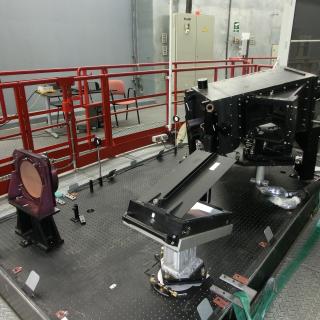
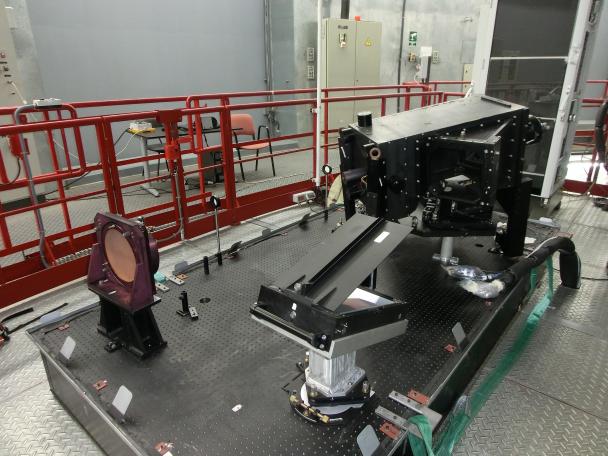
    Optical bench
    HORuS - High Optical Resolution Spectrograph
    High-resolution spectrograph for the 10-m Gran Telescopio Canarias (GTC) based on components from UES, a spectrograph which was in use at the 4.2-m William Herschel Telescope (WHT) between 1992 and 2001.
    Carlos
    Allende Prieto
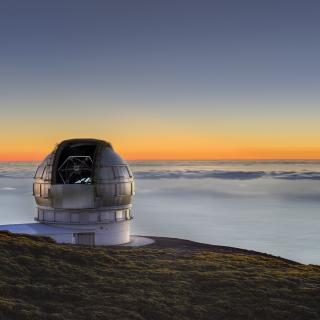
    Gran Telescopio Canarias (GTC)
    SEVERO OCHOA 2016 - 2019
    The IAC is an internationalized Spanish research centre aiming to achieve major advances in the understanding of the laws that govern the origin and evolution of the various forms of matter/energy in the Universe. Outstanding results are expected in key areas of research such as Solar physics, Sun-Earth connections, Exoplanetary systems, Solar
    Rafael
    Rebolo López