Magnetism, Polarization and Radiative Transfer in Astrophysics

    General
    Description

    Magnetic fields pervade all astrophysical plasmas and govern most of the variability in the Universe at intermediate time scales. They are present in stars across the whole Hertzsprung-Russell diagram, in galaxies, and even perhaps in the intergalactic medium. Polarized light provides the most reliable source of information at our disposal for the remote sensing of astrophysical magnetic fields, including those on the Sun. In particular, the diagnostics of solar and stellar magnetic fields requires the measurement and physical interpretation of polarization signatures in spectral lines, which are induced by various physical mechanisms taking place at the atomic level. In addition to the familiar Zeeman effect, polarization can also be generated by various other physical processes, such as atomic level polarization induced by anisotropic pumping mechanisms, quantum interference between fine-structured or hyperfine-structured energy levels, the Hanle effect, etc. Interestingly, the polarization produced by such mechanisms is sensitive to the physical conditions of the astrophysical plasma under consideration and, in particular, to the presence of magnetic fields in a parameter domain that goes from field intensities as small as 1 micro-G to many thousands of Gauss.

    The main objective of this project is to explore in depth the physics and origin of polarized radiation in astrophysical plasmas as well as its diagnostic use for understanding cosmical magnetic fields, with emphasis on the magnetism of the extended solar atmosphere. Our investigations deal with:

    -the theoretical understanding of relevant polarization physics, which requires new insights into the quantum theory of polarized light scattering in the presence of magnetic and electric fields.

    -the development of plasma diagnostic tools for the investigation of astrophysical magnetic fields, with emphasis on the magnetism of the extended solar atmosphere, circumstellar envelopes and planetary nebulae.

    -spectropolarimetric observations and their physical interpretation.

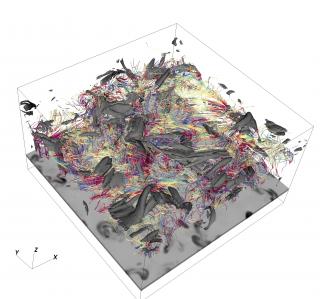
    -radiative transfer in three-dimensional models of stellar atmospheres, resulting from magneto-hydrodynamical simulations.

    -atomic and molecular spectroscopy and spectro-polarimetry, with applications in several fields of astrophysics.

    This research project is formed by a group of scientists convinced of the importance of complementing theoretical and observational investigations in order to face some of the present challenges of 21st century Astrophysics.

    Principal investigator
    1. We applied deep learning techniques to the analysis of observations. Using convolutional neural networks, we developed techniques for the deconvolution of observational data. These techniques were also used to accelerate the deconvolution process of ground-based observations, achieving a cadence of around a hundred images processed per second.
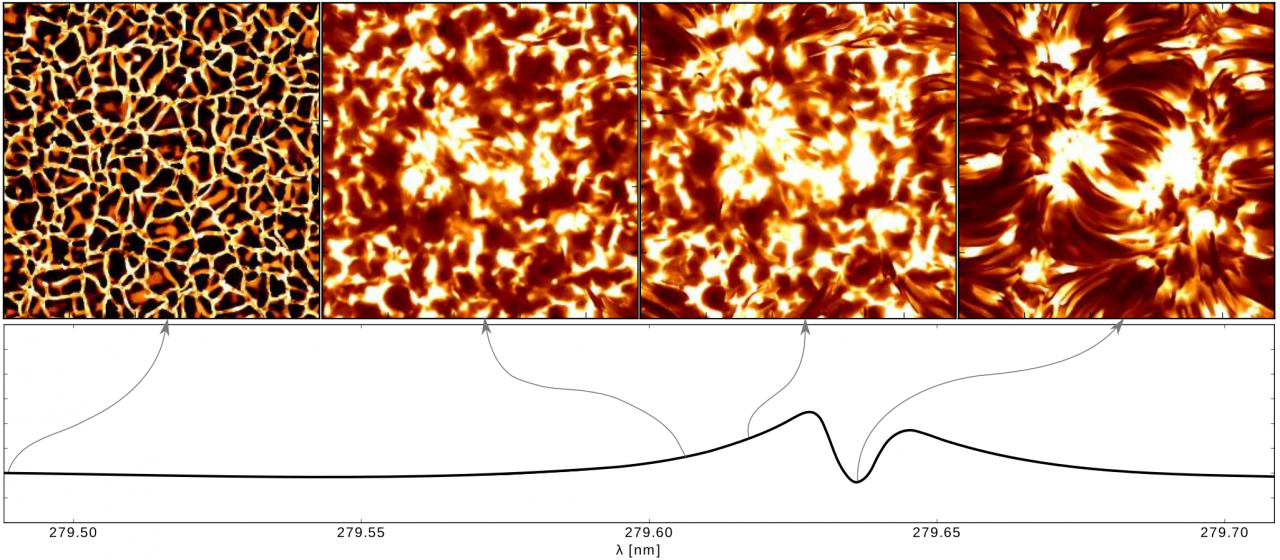
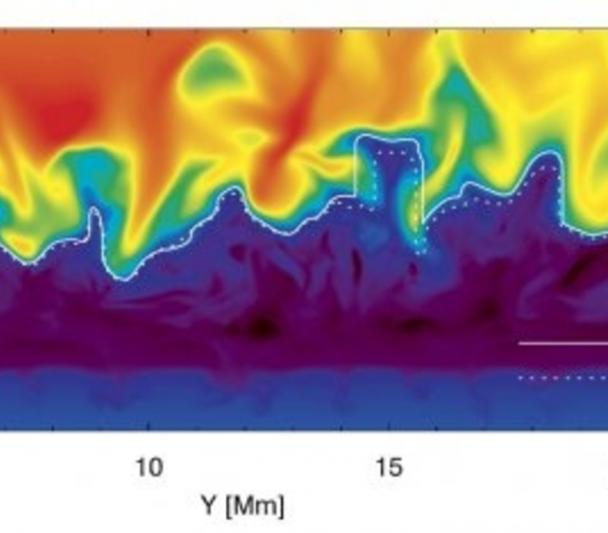
    2. We developed an inference technique based on bayesian statistics in order to interpret the observations provided by the CLASP international experiment. By parametrizing a state-of-the-art magneto-hydrodynamical model of the solar atmosphere, we found that the geometrical complexity of the transition region must be much more complex than the one provided by the model.
    3. We solved the problem of polarized radiation transfer in magneto-convection simulations that account for small-scale dynamo action for the Sr I line at 460.7 nm. We found that the model with most of the convection zone magnetized close to the equipartition and a surface mean field strength of 170G is compatible with the available observations.
    4. We studied the magnetic sensitivity of the Ca I line at 422.7nm. The linear polarization at the core is sensitive to the Hanle effect, while the linear polarization in the wings is sensitive to the magneto-optical effects, as a consequence of the newly found effect resulting from the joint action of partial redistribution and the Zeeman effects.
    5. We studied the formation of the H-alpha, Mg II h-k, and Ca II H-K and 845.2nm in a model atmosphere of a flaring bipolar active region, solving the radiation transfer problem taking into account partial redistribution in full 3D geometry and out of local thermodynamical equilibrium. We succeeded in reproducing common observational features of such flaring regions.
    Related publications

    The magnetic sensitivity of the Ca II resonance and subordinate lines in the solar atmosphere 2025A&A...704A.173J
    DKIST resolves sub-arcsec photospheric scattering polarization 2025A&A...703L..10Z
    Neural translation for Stokes inversion and synthesis 2025A&A...703A..55A
    Determining the Magnetic Field of Active Region Plages Using the Whole CLASP2/2.1 Spectral Window 2025ApJ...991..164A
    Determining the Magnetic Field in the Atmosphere of a Solar Active Region Observed by the CLASP2.1 Sounding Rocket Experiment 2025ApJ...990..200I
    Spectropolarimetric synthesis of forbidden lines in magnetohydrodynamic models of coronal bright points 2025A&A...700A.204A
    P-CORONA: A New Tool for Calculating the Intensity and Polarization of Coronal Lines in 3D Models of the Solar Corona 2025ApJ...987...39S
    A numerical approach for modelling the polarisation signals of strong resonance lines with partial frequency redistribution: Applications to two-term atoms and plane-parallel atmospheres 2025A&A...699A.233R
    Coronal Magnetometry with EUV Permitted Lines 2025ApJ...988...33S
    The uncertainty of magnetic fields in 3D non-local thermodynamic equilibrium inversions 2025A&A...699A..73S
    Inferring chromospheric velocities in an M3.2 flare using He I 1083.0 nm and Ca II 854.2 nm 2025A&A...699A.121K
    Transverse oscillations in 3D along Ca II K bright fibrils in the solar chromosphere 2025A&A...698A.124K
    Multi-wavelength spectropolarimetric observations of AR13724 performed by GRIS 2025A&A...698A..33Q
    Study of an active region prominence using spectropolarimetric data in the He I D<SUB>3</SUB> multiplet 2025A&A...696A.109E
    Reformulating polarized radiative transfer for astrophysical applications (I). A formalism allowing non-local Magnus solutions 2025OJAp....8E..31C
    Reduced atomic models for large-scale computations: Fe XIII near-infrared lines 2025MNRAS.537.3781D
    Exploring spectropolarimetric inversions using neural fields: Solar chromospheric magnetic field under the weak-field approximation 2025A&A...693A.170D
    Observations of umbral flashes in the resonant sunspot chromosphere 2025A&A...693A.165F
    The Impact of the Angle-average Approximation in the Partial Frequency Redistribution Modeling of the Mg II h–k Doublet Stokes Profiles 2025ApJ...978...27D
    Detection of a Magnetic Discontinuity in the Upper Solar Chromosphere Associated with a Coronal Loop Brightening Observed by CLASP2.1 2025ApJ...978..140S
    Non-local thermodynamic equilibrium inversions of the Si I 10827 Å spectral line 2024A&A...692A.169Q
    Accurate modeling of the forward-scattering Hanle effect in the chromospheric Ca I 4227 Å line 2024A&A...691A.278B
    Neural calibration of imaging Stokes polarimeters 2024BAAA...65..281I
    Full Stokes-vector Inversion of the Solar Mg II h and k Lines 2024ApJ...975..110L
    Magnetic diffusion in solar atmosphere produces measurable electric fields 2024NatCo..15.8811A
    Mapping the Longitudinal Magnetic Field in the Atmosphere of an Active Region Plage from the Inversion of the Near-ultraviolet CLASP2.1 Spectropolarimetric Data 2024ApJ...974..154L
    Magnetic field diagnostics of prominences with the Mg II k line 3D Stokes inversions versus traditional methods 2024A&A...689A.341S
    Properties of sunspot light bridges on a geometric height scale 2024A&A...689A.255E
    SiO maser polarization and magnetic field in evolved cool stars 2024A&A...688A.143M
    The Polarization of the Solar Ba II D<SUB>1</SUB> Line with Partial Frequency Redistribution and Its Magnetic Sensitivity 2024ApJ...964...64A
    Observation and Modeling of the Circular Polarization of the Cr I Magnetic-field-induced Transition at 533.03 nm 2024ApJ...964..155L
    Comparing Observed with Simulated Solar-disk-center Scattering Polarization in the Sr I 4607 Å Line 2024ApJ...964...10Z
    CMAG: A Mission to Study and Monitor the Inner Corona Magnetic Field 2023Aeros..10..987O
    Tomographic Reconstruction of the Solar K-Corona Using Neural Fields 2023SoPh..298..135A
    The Impact of Angle-dependent Partial Frequency Redistribution on the Scattering Polarization of the Solar Na I D Lines 2023ApJ...958...38J
    Polarized resonance line transfer in a spherically symmetric medium with angle-dependent partial frequency redistribution 2023MNRAS.526.6004S
    First Metis Detection of the Helium D<SUB>3</SUB> Line Polarization in a Large Eruptive Prominence 2023ApJ...957L..10H
    On the Magnetic Nature of Quiet-Sun Chromospheric Grains 2023ApJ...955L..40M
    Magnetic Field Information in the Near-ultraviolet Fe II Lines of the CLASP2 Space Experiment 2023ApJ...954..218A
    Magnetic field fluctuations in the shocked umbral chromosphere 2023A&A...676A..77F