
Bibcode
Ferreira, Paula S.; Hernández-Monteagudo, Carlos; Reis, Ribamar R. R.
Bibliographical reference
Journal of Cosmology and Astroparticle Physics
Advertised on:
12
2025
Citations
0
Refereed citations
0
Description
In this work we examine the baryon acoustic oscillations (BAO) in 2D angular and redshift space {θ, ∆z}, with ∆z denoting the redshift difference between two given angular shells. We thus work in the context of tomographic analyses of the large scale structure (LSS) where data are sliced in different redshift shells and constraints on Cosmology are extracted from the auto and cross-angular spectra of two different probes, namely the standard galaxy angular density fluctuations (ADF, or 2D clustering), and the galaxy angular redshift fluctuations (ARF). For these two observables we study by first time how the BAO peak arises in the {θ, ∆z} plane. Despite being a weak feature (particularly for ∆z ≠ 0), a Fisher forecast analysis shows that, a priori, most of the information on cosmological and galaxy bias parameters is carried by the BAO features in shell auto- and cross-angular power spectra. The same study shows that a joint probe analysis (ADF+ARF) increases the Fisher determinant associated to cosmological parameters such as H 0 or the Dark Energy Chevallier-Polarski-Linder (CPL) parameters {w 0,wa } by at least an order of magnitude. We also study how the Fisher information on cosmological and galaxy bias-related parameters behaves under different redshift shell configurations: including cross-correlations to neighbour shells extending up to (∆z)tot ∼ 0.6 ((∆z)tot ∼ 0.4) for ADF (ARF) is required for Fisher information to converge. At the same time, configurations using narrow shell widths (σ z ≤ 0.02) preserve the cosmological information associated to peculiar velocities and typically yield Fisher determinants that are about two orders of magnitudes larger than for wider shell (σ z > 0.02) configurations. In the context of upcoming surveys of the LSS like Euclid, DESI, Roman, J-PAS, LSST or CSST, these Fisher forecasts further motivate the tomographic use of pure angular anisotropies as an alternative approach to confront the cosmological predictions with observations, while providing a way to test consistency with standard 3D approaches to analyse LSS surveys.
Related projects
Cosmology with Large Scale Structure Probes
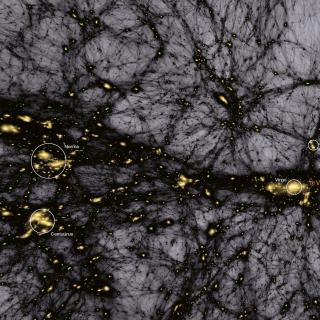
The Cosmic Microwave Background (CMB) contains the statistical information about the early seeds of the structure formation in our Universe. Its natural counterpart in the local universe is the distribution of galaxies that arises as a result of gravitational growth of those primordial and small density fluctuations. The characterization of the
Francisco Shu
Kitaura Joyanes